
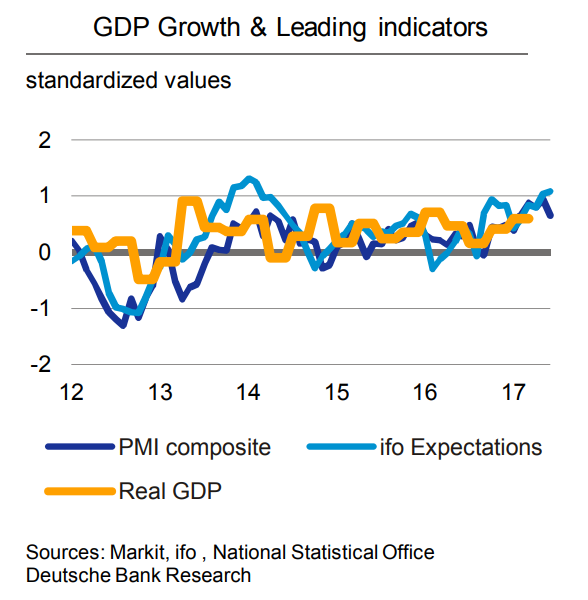
German economy is indeed firing on all cylinders. An accommodative fiscal and monetary policy stance, the upturn in world trade and low energy prices have supported the economic upturn gain momentum at the beginning of the year. Analysts expect these favourable conditions should remain in place in the coming quarters. After expanding at 0.6 percent in Q1, the economy is expected to maintain its robust growth rate in Q2, largely driven by domestic demand.
The main driver of GDP growth in the first quarter was net exports. Data released by the Federal Statistics Office on Monday showed that robust German exports pushed up trade surplus in May. Seasonally adjusted exports climbed 1.4 percent - their fifth consecutive monthly increase - while imports rose 1.2 percent, both figures beating expectations, the data from the Federal Statistics Office showed. The seasonally adjusted trade surplus edged up to 20.3 billion euros from a revised 19.7 billion euros in April.
Upbeat trade figures follow solid manufacturing data released last Friday which showed industrial output rose more than expected in May, boosting expectations that factories will support growth in the second quarter. Private consumption has been an important growth driver in the last few years and net exports are now providing additional support.
The International Monetary Fund (IMF) has raised its growth forecast for the German economy to grow by 1.8 percent in 2017 in real terms, compared with its April forecast of 1.6 percent, citing soaring domestic demand and rebounding exports. Meanwhile the IMF last week repeated its call for Germany to increase investment to help reduce its current account surplus and suck in more imports ... and thus help other countries.
"We have revised our GDP forecast for the whole year upwards to 1.6% (1.3%) which is equivalent to a calendar-adjusted rate of 2%. With an expected increase of 1.7% in 2018, German GDP is again likely to exceed the trend growth rate of around 1.25% – for the fifth successive year – and the positive output gap should widen to over two percentage points," said Deutsche Bank in a report.
EUR/USD was trading in a narrow 18 pip range on the day, hovering around 5-DMA support at 1.1394. EUR/GBP on the other hand was down 0.24 pct on the day, trading at 0.8828 at around 1125 GMT. FxWirePro's Hourly EUR Spot Index was neutral at 64.1177. For more details on FxWirePro's Currency Strength Index, visit http://www.fxwirepro.com/currencyindex.
FxWirePro launches Absolute Return Managed Program. For more details, visit http://www.fxwirepro.com/invest.


