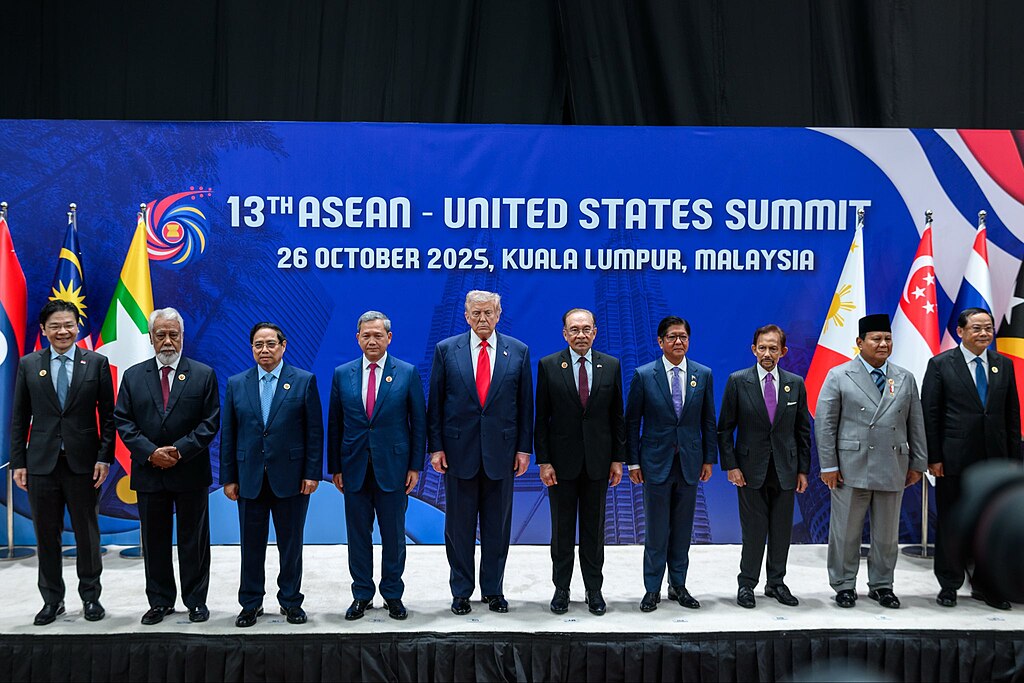
World leaders convened in Malaysia on Monday to explore stronger economic and trade cooperation as new U.S. tariffs loom, following President Donald Trump’s early departure from a Southeast Asian summit to continue his regional tour.
During his first Asia stop, Trump witnessed the signing of an expanded ceasefire agreement between Cambodia and Thailand, along with four regional trade accords. However, the White House confirmed that none of the deals reduced existing U.S. tariffs on Cambodia, Malaysia, Thailand, or Vietnam, though they left room for possible exemptions.
Trump emphasized Washington’s long-term commitment to Southeast Asia, stating, “The United States is with you 100% and will remain a strong partner for many generations.” His remarks came as U.S. and Chinese negotiators agreed to a temporary tariff truce in their ongoing trade conflict.
As Trump and Secretary of State Marco Rubio travel to Japan, Chinese officials, along with leaders from Brazil, Canada, the European Council, and ASEAN member nations, are working to fortify economic ties and advance trade agreements. China is expected to advocate for trade multilateralism and deepen regional partnerships while the U.S. delegation participates in ongoing discussions.
The China-led Regional Comprehensive Economic Partnership (RCEP), which includes 10 ASEAN countries plus Australia, Japan, New Zealand, and South Korea, is also on the agenda. Representing roughly 30% of global GDP, RCEP is viewed as a potential buffer against rising U.S. tariffs.
European Council President Antonio Costa met with Chinese Premier Li Qiang, urging Beijing to ease export controls on critical raw materials and restore stable supply chains. Meanwhile, Brazilian President Luiz Inacio Lula da Silva reported progress toward a more favorable U.S. trade deal following discussions with Trump, emphasizing Brazil’s economic leadership in South America.
The ASEAN bloc comprises Brunei, Cambodia, Indonesia, Laos, Malaysia, Myanmar, the Philippines, Singapore, Thailand, East Timor, and Vietnam.