


 Wall Street Ends Mixed as Investors Await CPI and Bank Earnings
  Trump Secures Russian Diesel Deal as US Fuel Prices Surge
  IMF Maintains 2027 Global Growth Forecast at 3.4% Amid Rising Risks
  S&P 500 Rally Masks Losses for Over 40% of Stocks in 2026
  Global Stocks Mixed as Oil Falls Ahead of US Earnings
  RBA Signals More Rate Hikes as Inflation Risks Rise
  Gold Prices Rise Above $4,200 as Russia-Ukraine Energy Truce Eases Oil Concerns
  Oil Prices Rise as Houthi Attacks Threaten Middle East Supply
  Oil Prices Surge Above $106 After Deadly Saudi Airport Attack
  Gold Prices Hit One-Week High as Oil Falls, Fed Rate Outlook Weighed
  Bank of America Predicts Yen Rebound as USD/JPY Faces Risks
  US Dollar Rises for Fourth Week as Fed Rate Hike Bets Grow
  Philippines Current Account Deficit Seen at $19.1 Billion in 2026
  Samsung, SK Hynix Shares Plunge as China Chip Competition Grows
  US Dollar Near 18-Month High Ahead of Inflation Data
  Deutsche Bank CEO Urges Faster German Economic Reforms


 Add as a preferred source on Google

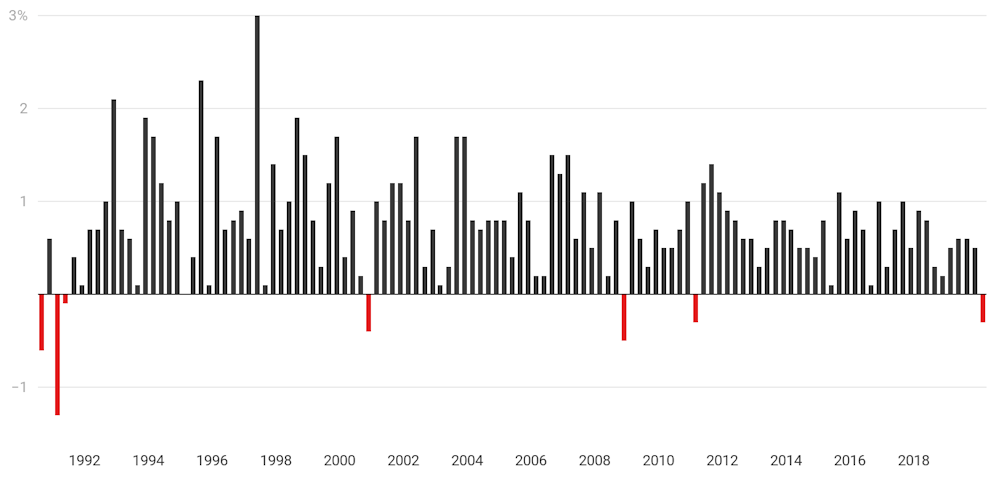
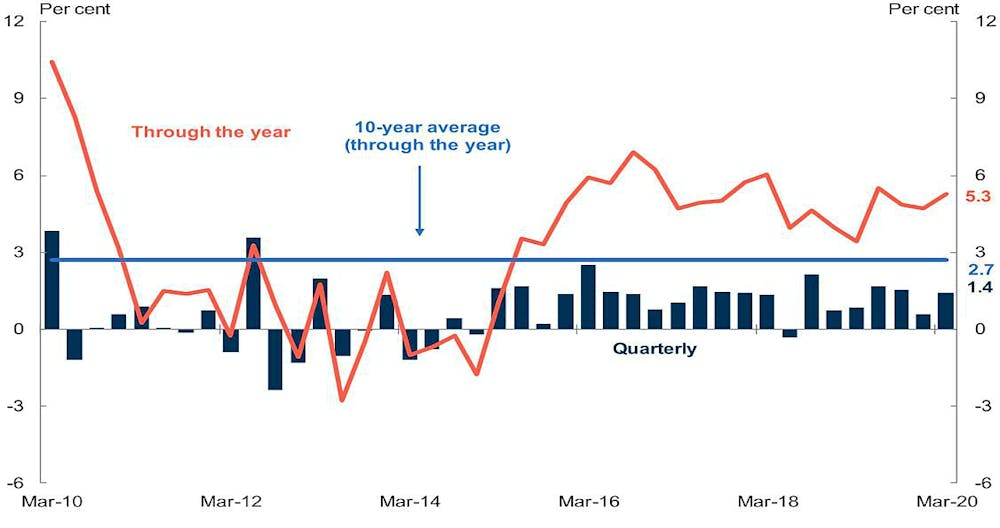
A go-slow on spending sent the economy backwards 0.3% in the first three months of this year, only the fourth such decline since Australia was last in recession in the early 1990s.
Treasurer Josh Frydenberg says treasury has told him that the next three months, the June quarter that we are in at present, will see a “far more severe” contraction, one private sector forecasters believe could be as high as 10%.
Asked whether that meant Australia was already in recession, he said it did.
Quarterly GDP growth since 1990
Most unusually for an economic downturn, household incomes rose throughout the quarter, pushed higher by a 6.2% increase in government payments related to COVID-19 and the bushfires, and an 11.1% increase in insurance payouts as a result of bushfires and hailstorms.
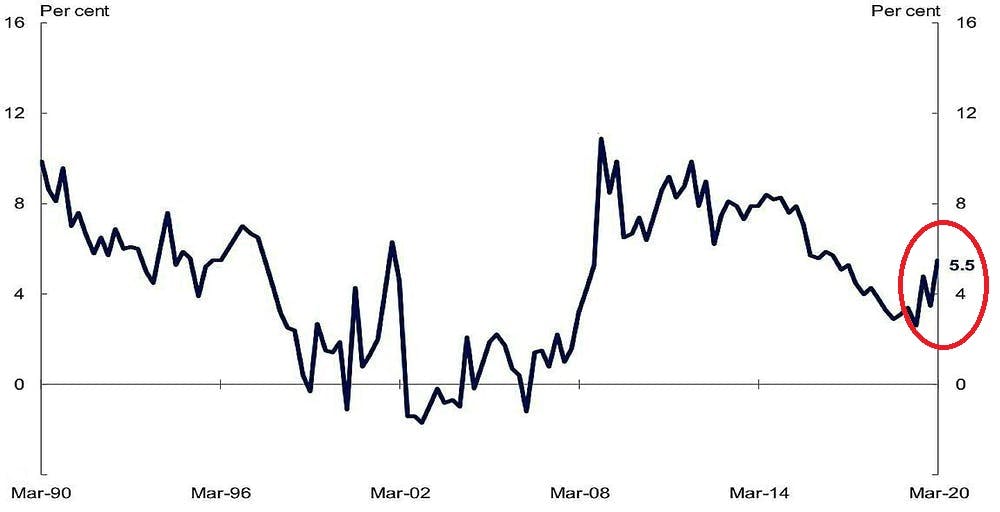
But rather than spend most of it, Australian households dramatically increased saving in the quarter, pushing the household saving ratio up from 3.5% to 5.5% and pushing down household spending 0.2%.
Household savings ratio
Commonwealth Treasury
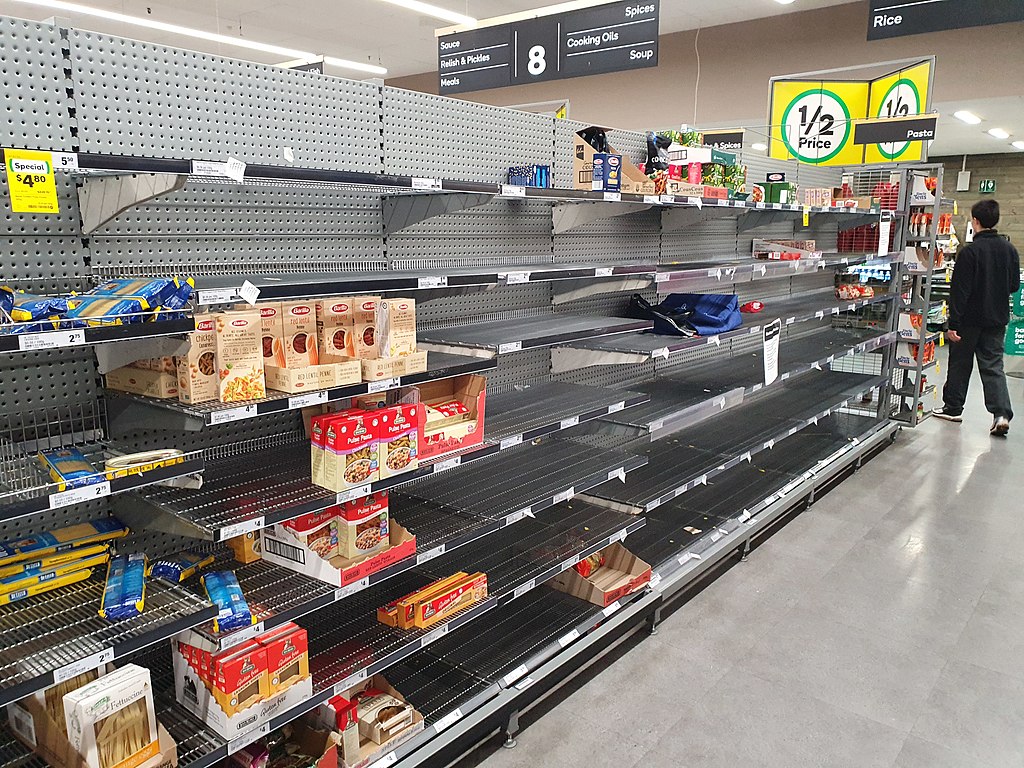
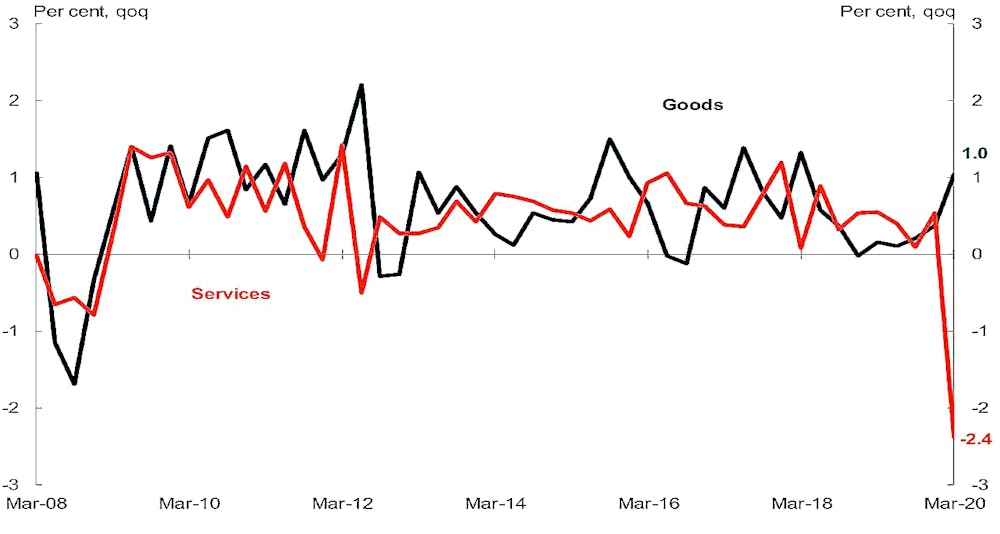
Spending on goods actually increased over the three months as Australians stocked up on essentials including toilet paper in March.
The production of “petroleum, coal, chemical and rubber products” surged 8.1% as consumers stocked up on cleaning and disinfectant products.
But spending on services plummeted, led down by dramatic falls in spending on transport and hotels, cafes and restaurants.
Household consumption, March quarter
Commonwealth Treasury
Spending on transport services (airlines and the like) fell 12.0%. Spending on hotels, cafes and restaurants fell 9.2%, each the biggest fall on record.
“Production” in these industries fell 4.9% and 7.5%. Profits fell 6.8% and 14.2%.
Spending fell on ten of the 17 consumption categories.
Household consumption by category, March quarter

Commonwealth Treasury
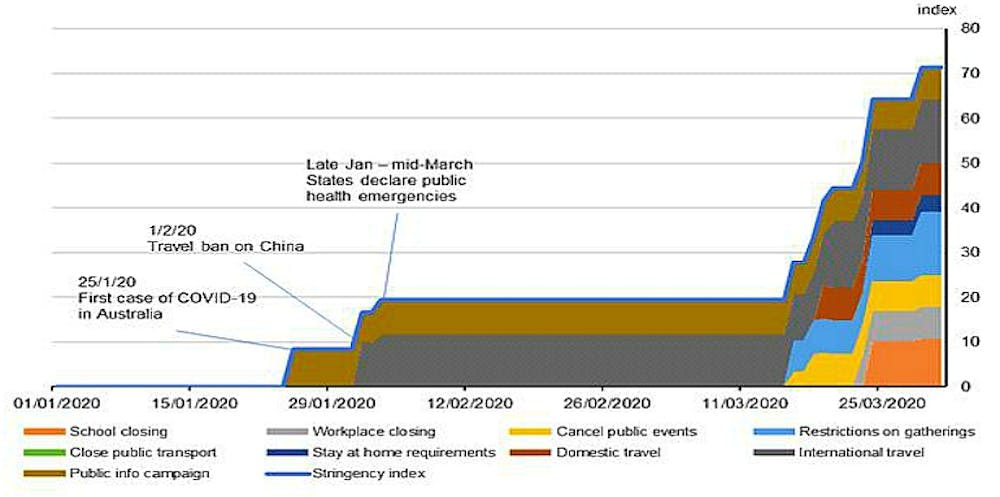
Most of the changes took place at the very end of the March quarter.
A new index of the “stringency” of COVID-19 containment measures released with the national accounts shows they ramped up only in the final two weeks.
Most have been in place for the entirety of the June quarter to date, suggesting the impacts on spending and production will be a “lot more substantial”, in the words the treasurer used in the national accounts press conference.
ABS stringency of containment measures index
Were it not for government spending, which has climbed 6.2% throughout the year, the plunge in March quarter GDP would have been much more severe.
Calculations of the Bureau of Statistics suggest it would have been twice as severe, a March quarter decline of 0.6% rather than 0.3%.
General government expenditure
Commonwealth Treasury
The treasurer described Australia as “on the edge of the cliff” in the March quarter, facing “an economist’s version of Armageddon”.
The treasury had been contemplating a fall in gross domestic product of 20% in the June quarter. Australia has avoided that fate by acting on health and the economy early.
Its fall in GDP of 0.3% in the March quarter was one third the OECD average.
International comparisons, real GDP growth, March quarter

Commonwealth Treasury
The treasurer has scheduled an economic update, which will include the result of a review of the JobKeeper program.
Asked whether it could be referred to as a mini-budget, he said it could be.
Peter Martin ne travaille pas, ne conseille pas, ne possède pas de parts, ne reçoit pas de fonds d'une organisation qui pourrait tirer profit de cet article, et n'a déclaré aucune autre affiliation que son poste universitaire.







