


 Oil Prices Slip as Trump Rules Out Iran Strike Before Midterms
  Iran Refuses to Halt Uranium Enrichment Amid US Nuclear Demands
  Gold Prices Fall Amid Rate Jitters; Copper Steady as China Stimulus Eyed
  US, EU Push for Action Against Asia’s Excess Factory Capacity
  Oil Prices Rise as Gulf Hurricane and Middle East Supply Risks Mount
  UK Finance Minister Healey Calls for Fiscal Discipline Amid Global Risks
  Asian Stocks Mixed as OpenAI Revenue Concerns Hit Chipmakers
  Gold Prices Rise Above $4,200 as Russia-Ukraine Energy Truce Eases Oil Concerns
  Oil Prices Rise as Hormuz Risks Offset IEA Stock Release
  US Treasury Yields Ease After Strong 10-Year Auction as Global Bonds Struggle


 Add as a preferred source on Google
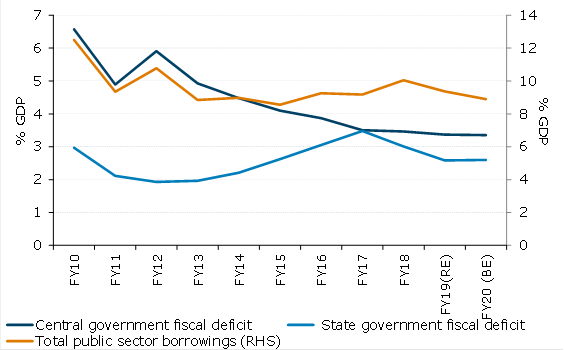
The inability of bond yields to break lower despite an unprecedented scale of liquidity infusion by the Reserve Bank of India (RBI) and expectations of further monetary easing is explained by the worsening fiscal position, according to the latest report from ANZ Research.
The government has now deviated from the fiscal roadmap in four of its five years in tenure. The medium term fiscal deficit target of 3 percent of GDP, initially to be achieved in FY17 (fiscal year ending March 2017) has been pushed out to FY21 (fiscal year ending March 2021).
Higher off-budget funding of public capital spending has also under-stated the real extent of India’s fiscal deficit. The management of the disinvestment process has also shifted from initial public offerings to the public to private placements with state-owned insurance companies and share buybacks by state enterprises, the report added.
At the current run rate, the combined central-state government debt ratio of 60 percent can be attained by the revised timeline of FY25 as laid out in the fiscal roadmap. This is however, sensitive to the underlying assumptions, especially nominal GDP growth.
"The current accommodative fiscal-monetary mix has not filtered through to the currency market as yet. The closure of the output gap, which will also result in a widening of the current account deficit, could well be the inflexion point," ANZ Research further commented.







