


 RBI Raises Repo Rate to 5.50% in Hawkish Shift on Inflation Risks
  RBA Says ASX Still Falls Short on Governance and Risk Controls
  Oil Prices Mixed as Russia Diesel Deal and Houthi Attacks Raise Supply Concerns
  Wall Street Closes Lower as Bank Earnings and AI Concerns Weigh
  Wall Street Ends Mixed as Investors Await CPI and Bank Earnings
  Philippines Current Account Deficit Seen at $19.1 Billion in 2026
  US Dollar Index Falls as Fed Signals Caution, Indian Rupee Surges
  Fed’s Williams Signals One More Rate Hike Before Year-End
  RBA Hikes Interest Rate to 4.60% as Inflation Risks Rise
  Nasdaq Falls as Oil Prices Surge Ahead of Bank Earnings


 Add as a preferred source on Google
According to the latest report from ANZ Research, it is unnecessary for the People’s Bank of China (PBoC) to employ broad-based monetary easing. We may see marginal tightening in interbank market liquidity conditions and hence a rise in short-end rates.
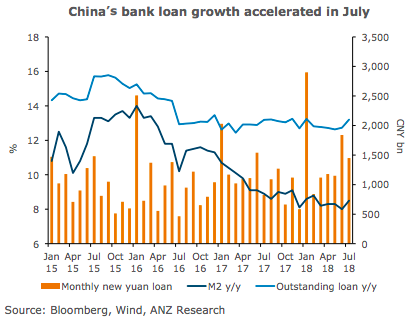
China’s central bank is focusing on credit easing and improving the transmission mechanism of monetary policy with targeted measures. This has been effective so far, as evidenced in the acceleration in loan growth in July.
Further, the rise in bank loans in July suggests that China’s policy actions have been effective. New yuan loans jumped to CNY1.45 trillion in July this year, compared with CNY0.83 trillion in July last year and CNY0.46 trillion in July 2016.
As a result, outstanding CNY loans expanded 13.2 percent in July compared with 12.7 percent in June, and the M2 broad money supply rose 8.5 percent y/y in July compared with 8.0 percent in June. Although shadow banking activities are still shrinking, as reflected in July’s aggregate financing (CNY1.04 trillion or 10.3 percent y/y) figures, the acceleration in bank loan growth will support overall financial conditions.
Meanwhile, fiscal policy will continue to contribute more to stabilising total demand. The recent debates between the PBoC and the Ministry of Finance (MoF) have attracted much publicity in China. Following this, the minutes from the executive meeting of the State Council on July 30 stated that “the proactive fiscal policy should be more effective", the report added.







