
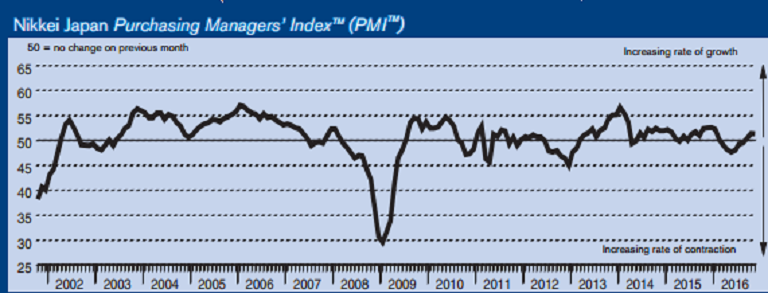
Japan’s manufacturing sector performed best in almost a year during November, remaining higher than the series’ long-run average. Production increased at a slightly slower pace, albeit one that remained stronger than the long-run series average. This was driven by new order growth, which picked up to a ten-month high.
The headline PMI posted at 51.3 in November, little-changed from October’s 51.4, the highest reading since January, thereby signaling a solid improvement in manufacturing conditions in Japan. In contrast, employment growth eased to the weakest in three months. Meanwhile, on the price front, input prices and charges remained broadly unchanged from October.
Total new orders also increased in November. In fact, the rate of expansion was the most marked since January. Greater foreign demand also contributed to the expansion in total sales, with new export orders increasing for the third successive month. The rate of growth eased, but was nevertheless stronger than the historical average.
Finally, input prices broadly stabilized, following a ten-month sequence of decline. Selling prices also remained broadly unchanged from October.
Meanwhile, the USD/JPY currency pair has weakened, forming a bearish pattern at 113.95, down 0.42 percent, while at 6:00GMT, the FxWirePro's Hourly Yen Strength Index remained slightly bearish at -82.45 (a reading above +75 indicates a bullish trend, while that below -75 a bearish trend). For more details, visit http://www.fxwirepro.com/currencyindex

