


 Elon Musk Donates $366 Million to 2026 US Midterms
  US Condemns China Sanctions on Taiwan Allies Belize and Paraguay
  US Recalls Nicaragua Envoy After Ambassador Rejection
  MI5 Warns of Rising Iran, Russia Threats and AI Bioweapon Risks
  US Senate Midterms 2026: Key Races That Could Flip Control
  Kim Jong Un Showcases ICBM Ahead of Possible Trump Meeting
  NATO Commander Warns Russia of Devastating Response to Attack
  North Korea Fires Ballistic Missiles Amid Rising Tensions With South Korea
  Jordan Bardella Antisemitism Allegations Threaten Le Pen’s Campaign
  China Resumes US Soybean Purchases After Trump-Xi Summit
  Most Americans Oppose Election Betting on Prediction Markets, Poll Finds
  Flavio Bolsonaro Backs Brazil’s 40-Hour Workweek Reform Ahead of Runoff
  US Supreme Court Denies Release of Anti-ICE Activist Kyle Wagner
  Trump Denies Russia and China Are Helping Iran in U.S. Conflict
  Trump Defends Russian Diesel Deal Amid US Sanctions Backlash
  Italy’s Meloni Warns US-Russia Diesel Deal Could Weaken Ukraine Sanctions
  SpaceX Starlink Restrictions Disrupt Ukraine Military Operations


 Add as a preferred source on Google
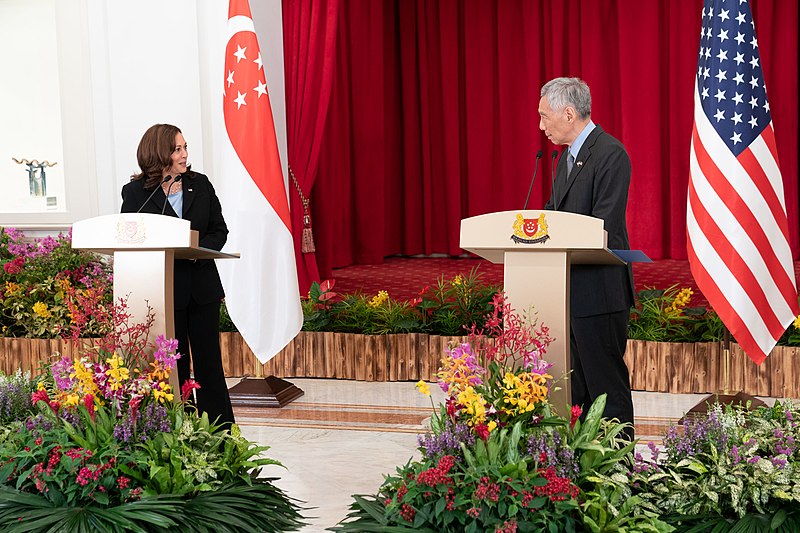
US Vice President Kamala Harris is currently in Southeast Asia for her Singapore and Vietnam visits. During her first stop in Singapore, Harris also weighed in on the tensions surrounding the South China Sea and accused China of trying to intimidate the surrounding countries.
Harris’s first stop in her Southeast Asia visit was in Singapore, as part of the US under the Biden administration’s efforts to re-engage with allies in the key region after experiencing strained relations under the Trump administration. Harris’s visit also comes in the midst of the ongoing withdrawal of troops and civilians in Afghanistan that has raised questions of US credibility. In her remarks during the joint press conference held with Singaporean Prime Minister Lee Hsien Loong, Harris assured that Washington has an enduring commitment to the region.
Harris also weighed in on the tensions surrounding the South China Sea, accusing China of trying to intimidate and pressure the surrounding countries. China claims to have sovereignty over most of the disputed waters, but its claims overlap with similar assertions from the surrounding countries. The international tribunal also rejected China’s claim, which Beijing has dismissed and continues to insist upon.
“Beijing continues to coerce, to intimidate, and to make claims to the vast majority of the South China Sea,” said the vice president. “Beijing’s actions continue to undermine the rules-based order and threaten the sovereignty of nations. The United States stands with our allies and partners in the face of these threats.”
China has continued to assert control over the resource-filled waters by making incursions even into the exclusive economic zones and airspaces of the surrounding countries. Beijing has also built artificial islands as it builds its military presence in the region.
Vietnam is Harris’s next stop in her visit to the region, with Harris being the first US vice president to visit the country. Biden administration officials announced this week that the trip was met with some slight delay due to an investigation into two potential cases of the Havana Syndrome in Hanoi. While the investigation was in its early stages, officials said that it was safe for Harris to continue her trip.
Havana syndrome refers to a set of mysterious health issues first reported by US diplomats and other government officials in Havana, Cuba, back in 2016.







