


 TSMC Profit Set to Surge 65% as AI Chip Demand Drives Record Earnings
  Moonshot AI Executives Seek Settlement Ahead of Hong Kong IPO
  Orsted to Take Full Ownership of UK Offshore Wind Farm for £15 Million
  Canton Network Expands in South Korea With Major Partnerships
  Ledger Investigates Alleged $86 Million Crypto Wallet Theft
  Coinbase CEO Backs SEC Accredited Investor Reform
  Arthur Hayes Announces FLOP Testnet Launch Within Weeks
  Nasdaq Faces Pullback to 26,225 Despite Bullish Outlook, UBS Says
  Blockchain.com Seeks CFTC Approval for Prediction Markets and Crypto Derivatives
  Apple Supplier Luxshare Sees Limited Impact From US Patent Probe
  Ethereum Foundation-Linked Wallets Move $11.13M in ETH to Kraken
  Uber Exits Four African Markets Amid Rising Competition
  Ripple Chairman Chris Larsen Donates $22.5 Million Ahead of US Midterms
  Amazon in Talks to Acquire AI Startup Decart for $7 Billion
  MSTR Stock Rises as Barclays Raises Price Target to $175
  INWIT Shareholders Explore $7.1 Billion Take-Private Deal
  Samsung, SK Hynix Shares Fall as China's CXMT Advances DRAM Technology


 Add as a preferred source on Google
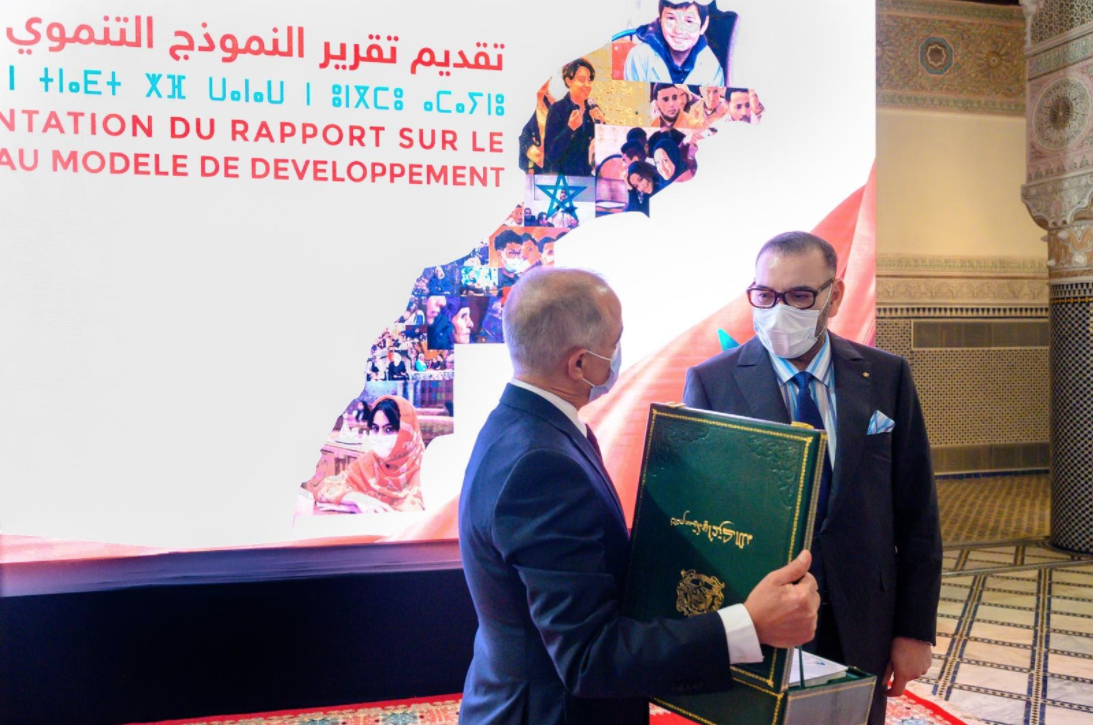
18 months after its creation by King Mohammed VI, the Special Commission on the Development Model (CSMD) of Morocco finally released its roadmap. In a 170-pages document, the commission proposes "a credible and achievable path of change". The first copy was given to the King, who presided over the presentation ceremony of this document on Tuesday 25 May at the Royal Palace in Fez.
"The proposed development model is a forward-looking vision of the Morocco of tomorrow," were the first words of Chakib Benmoussa, following the audience at the Royal Palace in Fez. In his speech, the CSMD Chairman outlined the contours of a new development course before the King of Morocco and officials including royal advisors and members of the government, notably the Head of Government, Saad Dine El Otmani, the President of the House of Representatives, Habib El Malki, the President of the Senate, Hakim Benchamach, HM the King's advisors, Omar Azzimane and Fouad Ali El Himma, and the presidents of the constitutional bodies.
This is a new step towards gearing up the Moroccan ambition. For the CSMD, the Morocco of 2035 will be a country "of value creation, which makes the most of its potential in a sustainable, shared and responsible manner".
This long-awaited report on the New Development Model (NMD) is based on the Kingdom's achievements and draws its material from a process of listening and consultation unprecedented in its scope.
The result of a broad participatory process of listening, debate and collective intelligence the commission’s strategy is the result of a multidimensional approach and a rigorous framing of its work. However, the commission specifies that the report is "neither a miracle solution to the dysfunctions identified, nor a compilation of sectoral policies, and even less an instruction manual for a governmental or partisan programme".
Among the objectives established by the commission: doubling the gross domestic product per capita by 2035, mastery of basic learning at the end of the primary cycle by more than 90% of students, increasing the number of doctors per capita to reach WHO standards, reducing the share of informal employment to 20%, increasing the participation rate of women to 45%, against 22% in 2019, and a citizen satisfaction rate with the administration and public services of more than 80%.
A roadmap for the future
To reach this expected milestone, the CSMD advocates a new organisational doctrine to "strengthen joint action and seal the commitments of actors".
Overall, the document is composed of three main parts: the diagnostic part; the part devoted to public governance; and the part consisting of the roadmap. The roadmap comprises 4 axes with concrete proposals in each axis. The report also includes flagship projects in different areas. And finally, a diagnosis, methods, a strategic roadmap and operational levers.
Through this roadmap, the commission proposes a "National Pact for Development" as an implementation mechanism. A proposal validated by King Mohammed VI. According to the press release from the Royal Cabinet, this proposal deserves to be retained and implemented "as a common reference for all the active forces in their diversity". Another proposed mechanism, under the authority of the Sovereign, will be dedicated to the follow-up of the NMD, to the impetus of the strategic building sites and to the support to the management of change.
On the economic front, the committee considers it fundamental to accelerate its transformation to make it dynamic, diversified and competitive, creating added value and decent jobs, and generating resources to finance social needs. To achieve this, greater emphasis should be placed on strengthening the resilience and adaptation capacity of the national economy to the shocks induced by the current Covid-19 crisis as well as to other types of crises whose frequency and intensity could increase in the future.
Furthermore, the commission calls for a "systemic and silo-free approach" for sectors hit hard by the consequences of the health crisis, including agriculture, tourism, and education/health.
In agriculture, the current health crisis has highlighted the challenges of food sovereignty and the development of modern, high value-added, inclusive and responsible agriculture.
As for tourism, the effects of the health crisis call for a rethinking of its development in a perspective of resilience and
sustainability. In the medium to long term, a new lease of life for the sector could be brought about by exploiting all the assets of the territories, both to boost domestic tourism and to attract new segments of world demand.
With regard to health and education, the foundations for improving human capital, the Commission recommends substantially strengthen the supply of public services throughout the country and ensure equitable access to them, alongside a private sector that is a responsible and ethical partner; emphasise the quality of services, as measured by the achievements of pupils, the level of competence of students and their employability, and by a supply of health care that makes the generalisation of health coverage effective; enhance human resources and strengthen their capacities, whether they be teachers, researchers, doctors or health personnel.
However, the success of the NMD remains dependent on an adequate financing strategy. To this end, the commission believes that the transformational reforms of the NMD will generate growth and a substantial return on investment and will ultimately ensure the financial sustainability of the model.
Now, the next step for the CSMD will be to carry out a vast operation of restitution and explanation of its conclusions and recommendations, to citizens and different actors across all regions of the Kingdom.
This article does not necessarily reflect the opinions of the editors or the management of EconoTimes







