


 Yen Sinks as BOJ Rate Hike Fails to Impress Markets
  Robinhood Buys $25 Million in Bitcoin for Corporate Treasury
  China Shuts 670 Banks as Bitcoin Eyes Financial Risks
  Dollar Near 18-Month High as Euro, Yen and Pound Weaken
  BOJ Signals Faster Rate Hikes as Inflation Risks Grow
  RBA Says ASX Still Falls Short on Governance and Risk Controls
  Ethereum Price Drops Below $2,600 as Long Liquidations Hit 4-Month High
  Gold Prices Rise as Hormuz Tensions Fuel Inflation Risks
  France to Release 10 Million Barrels of Diesel to Ease Fuel Prices
  Bitcoin Price Falls Below $83K as Liquidations Hit $697M
  Fed’s Williams Signals One More Rate Hike Before Year-End
  Sector Spotlight: Data Availability and Storage Lead 24-Hour Market Gains
  Litecoin Marks 15 Years as Grayscale Backs LTC ETF Push
  European Stocks Fall as Oil Rises Ahead of Fed Minutes


 Add as a preferred source on Google
The minutes from the ECB meeting July 20-21 showed the central bank was cautiously optimist and keen to contain stimulus hopes at meeting after Brexit vote. There was general agreement among the ECB Governing Council on the outlook, risk and policy actions post-Brexit. Members felt it was too early to assess with any certainty the possible implications of UK referendum. Members, therefore, felt it was premature to discuss any possible monetary policy reaction at this stage.
At its July meeting, the ECB stopped short of signaling that it would boost its stimulus again soon. Mr. Draghi has urged investors to wait to see the full effects of its recent policy measures, which include subzero interest rates, €80 billion ($90.18 billion) a month of bond purchases and cheap loans for banks.
There was broad agreement that the monetary policy measures in place since June 2014 continued to contribute to favourable bank lending conditions and to a strengthening of credit growth. Inflation was expected to increase further over the coming years owing to stronger domestic demand, tighter labour markets and improved corporate profitability, supported by the pass-through of the ECB’s monetary policy measures.
Overall, there was wide agreement that downside risks to the economic outlook for the euro area had increased. Members viewed that the Governing Council needed to reiterate its capacity and readiness to act, if warranted, to achieve its objective, using all the instruments available within its mandate, while not fostering undue expectations about the future course of monetary policy.
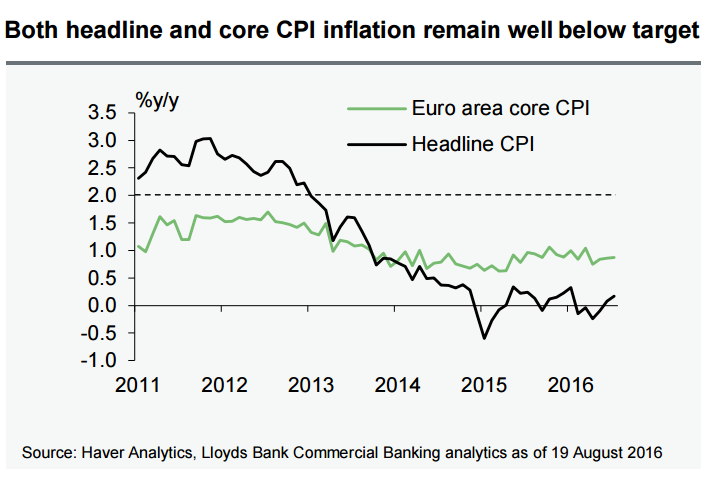
ECB's next monetary policy meeting will take place on September 8 in Frankfurt and economic data, particularly inflation will be the main consideration. Data released on Thursday showed that eurozone inflation was 0.2 percent in July, still far below the ECB’s target of just under 2 percent, with core inflation running at 0.9 percent. With core inflation not trending higher, still indicating modest price pressure and the economic outlook uncertain, most economists still expect the ECB to announce fresh policy measures in September when new economic forecasts will factor in the likely impact of Brexit.
Capital Economics forecasts the ECB would up the pace of its monthly asset purchases to 90 billion euros ($102 billion) from 80 billion euros, extend the purchasing program by six months and cut the deposit rate to -0.5 percent in September. "It is quite possible the bank will hold at least one of these measures back for later, but we are convinced that all three will be needed before long," Jennifer McKeown, economist at Capital Economics, said in a report on Thursday.
EUR/USD was trading at 1.1322 at around 10:30 GMT, down 0.26 percent on the day.







