


 Bumble Shares Surge 50% on $1 Billion Buyout Talks
  TSMC Q3 Revenue Beats Estimates as AI Chip Demand Surges
  Elon Musk Accuses Indian Telecom Giants of Blocking Starlink Launch
  Russia Approves Sberbank for Crypto Exchange Services
  Nvidia’s China AI Chip Market Share Falls to 34% as Huawei Gains Ground
  Trump Buys Up to $25M in Meta Stock, Invests in SpaceX Debt
  Amazon in Talks to Acquire AI Startup Decart for $7 Billion
  Morgan Stanley Predicts $10 Trillion RWA Market by 2030
  Epic Games Delays Disney Shooter, Shifts to AI-First Development
  Tencent Shares Fall as $5 Billion AI Bond Sale Weighed
  Canton Network Expands in South Korea With Major Partnerships
  Airbus Tests Valkyrie Combat Drone in Europe for Eurofighter Integration
  TSMC Profit Set to Surge 65% as AI Chip Demand Drives Record Earnings
  Albertsons Seeks $9.3 Billion From Kroger Over Failed Merger
  Oracle Uses Trucked Natural Gas to Power AI Data Centers Amid Pipeline Delays
  Nasdaq Faces Pullback to 26,225 Despite Bullish Outlook, UBS Says
  Syndax Stock Drops 15% After Axatilimab Trial Failure


 Add as a preferred source on Google
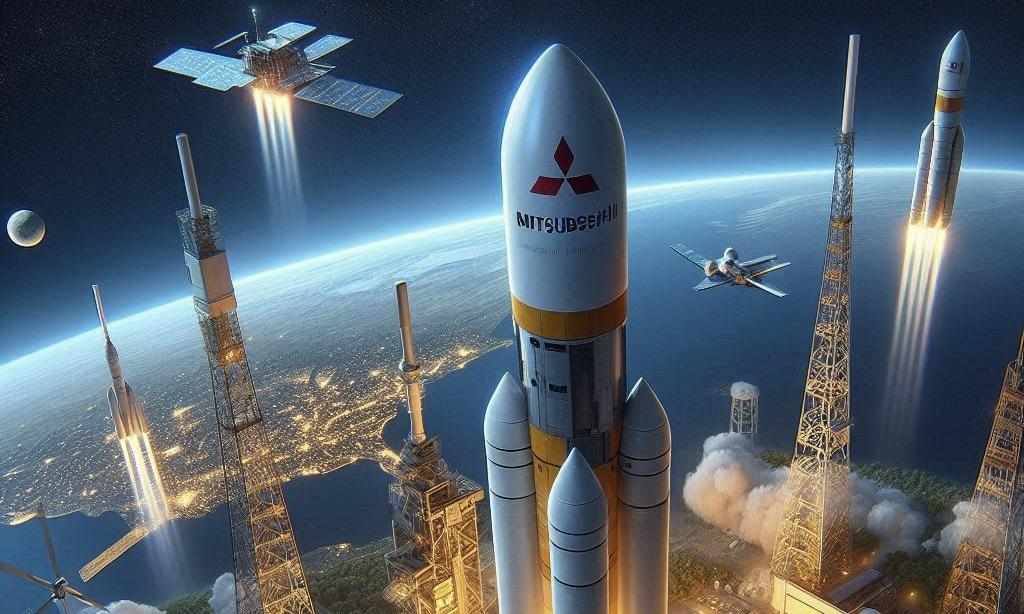
Mitsubishi Heavy Industries will begin launching multiple satellites for French operator Eutelsat in 2027 using its H3 rocket. This partnership marks a significant milestone for Mitsubishi's efforts to compete globally in the commercial launch industry, offering a cost-effective alternative to SpaceX.
Mitsubishi Heavy Expands Commercial Launch Efforts with Eutelsat Satellite Deal Using H3 Rocket
Mitsubishi Heavy Industries has secured the second commercial customer for its new H3 launch vehicle. According to Nikkei Asia, the vehicle will launch multiple satellites for French satellite operator Eutelsat. This move significantly boosts the Japanese company's efforts to establish itself as a viable participant in the commercial launch industry.
Mitsubishi Heavy has been responsible for developing and operating Japan's primary launch vehicles for decades. However, the services have been primarily provided to government agencies, including the Japan Aerospace Exploration Agency (JAXA) and the International Space Station.
The H3 medium-lift launch vehicle has been operational since this year, with the distinct objective of offering a competitive service in the global market. In 2018, Inmarsat, a British satellite telecommunications corporation now a California-based Viasat subsidiary, was announced as the H3's inaugural commercial customer.
The Paris-based company operates a low-earth-orbit constellation of over 600 satellites, which it acquired with OneWeb last year. Additionally, Eutelsat operates 35 geostationary satellites.
Mitsubishi Heavy to Begin Eutelsat Satellite Launches with Cost-Effective H3 Rocket in 2027
According to a statement issued by the Japanese company on September 18, the launches will commence in 2027. The two companies did not specify the type of satellite or the orbit into which it will be launched.
According to Eutelsat, utilizing the H3 launch vehicle "provides supplementary opportunities and diversity" for satellite launch. SpaceX rockets have recently been used to launch Eutelsat satellites.
The H3 rocket is Japan's response to SpaceX's Falcon 9, the world's most extensively used launch vehicle, and is designed to succeed the H2A rocket, which is scheduled to be retired by March.
Mitsubishi Heavy's objective with the H3 is to reduce the launch cost by 50% to $50 million, a figure the company claims is comparable to Falcon 9. Although H2A achieved a 98% success rate in its launch, it has yet to be commercially successful due to its excessive costs. It has transported satellites for the space agencies of South Korea and the United Arab Emirates, as well as for entities such as Telesat of Canada and Inmarsat of the United Kingdom.
Mitsubishi Heavy and JAXA jointly developed the H3 rocket, a successor to the H2A and H2B rockets.
Two additional H3 and H2A rockets are scheduled for the fiscal year ending in March 2025. The most recent H3 launch occurred in July.







