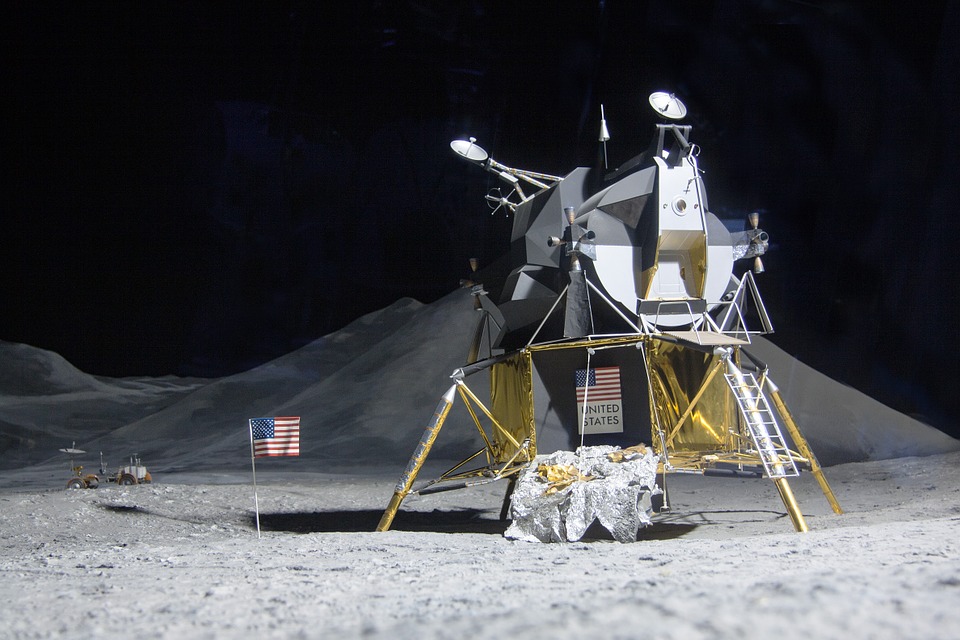
Neil Armstrong and Buzz Aldrin made history as the first two men to set foot on the surface of the moon back in 1969. Recently, in an interview with Professor Brian Cox, Aldrin revealed that there was one aspect of the Apollo 11 mission that was completely out of their hands.
Express reports that Aldrin shared the aspect of the iconic Apollo 11 mission that neither him, Armstrong, nor fellow astronaut Michael Collins, could not control. In an interview at the Science Museum, Aldrin shared that they had no control over piloting the Saturn V rocket outside of Earth’s orbit and that it was completely up to the agency’s computer programming. “You’re not piloting anything, you’re along for the ride,” said Aldrin.
However, he did note that there was still something they could do in case something went wrong. “There’s a way you could do some steering, nobody has ever done it,” added the astronaut. “There is that provision with the end controller, that if the guidance from the engine started to veer off, you could possibly get it straightened away, then separate.”
Aldrin also explained how the Apollo 11 mission was different from the previous space mission he went on, with the Gemini spacecraft that he refers to as a “Pilot’s spacecraft.” “Apollo was so programmed in its pathway, that it wasn’t just the sort of thing you could move around. Everything was very well-orchestrated to be part of the total flight plan.”
Back in 2013, Armstrong made another revelation regarding the iconic moon mission. The late astronaut shared that their moon landing may have prevented further tensions between the United States and the Soviet Union at the time, who was in the midst of the Space Race - a part of the Cold War. “It was the ultimate peaceful competition, USA versus USSR,” said Armstrong. “I’ll not assert that it was a diversion which prevented a war, but nonetheless it was a diversion.”
Armstrong went on to explain how this mission eventually benefited both sides after years of competing against each other in a ballistic missile-based nuclear arms race that came after World War II.