


 Chainlink Price Drops 3% Despite New CCIP Vault Launch
  European Stocks Fall as Oil Rises Ahead of Fed Minutes
  Gold Prices Fall as Fed Signals Another Rate Hike
  US Government Moves $1 Billion in Bitcoin Amid Sale Speculation
  Dogecoin Liquidations Surge as DOGE Bulls Face Heavy Losses
  XRP Ledger Activates New Security Feature for Banks and Stablecoins
  France to Release 10 Million Barrels of Diesel to Ease Fuel Prices
  Iran Refuses to Halt Uranium Enrichment Amid US Nuclear Demands
  Ledger Investigates Alleged $86 Million Crypto Wallet Theft
  US Treasury Yields Ease After Strong 10-Year Auction as Global Bonds Struggle
  Cardano Hits Record 436 TPS as Network Scaling Advances
  Asian Currencies Mixed as Yen Weakens, Dollar Holds Firm
  Wall Street Falls as Oil Prices Rise and Tech Stocks Slide
  Fed Minutes Signal Another Rate Hike by Year-End
  Bangladesh GDP Growth Accelerates to 4.6% on Industrial Rebound


 Add as a preferred source on Google
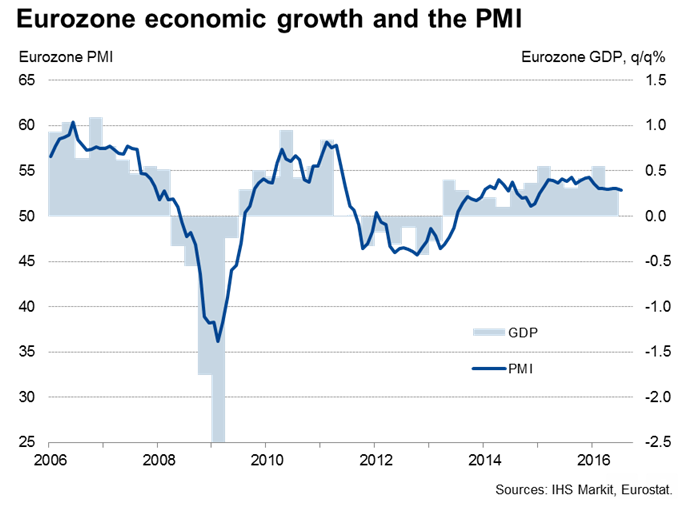
According to the preliminary estimates released on Friday, the Euro area recorded a tepid economic growth of 0.3 percent q/q in the second quarter of 2016. The reading was in line with market expectations but was well short of 0.6 percent q/q growth recorded in the previous quarter.
After the strong growth in the first quarter which was helped by some temporary factors like the mild winter weather, some pay-back in the second quarter was expected. On a yearly basis, eurozone GDP was up 1.6 percent, slightly less than the upwardly revised 1.7 percent recorded in the first quarter.
French statistics office released GDP data earlier on Friday which showed growth of the euro zone's second-largest came in at a worse-than-expected at zero due to weak consumer spending. The disappointing zero percent growth in France, largely due to a decline in inventories, was one of the culprits behind the weaker Eurozone growth performance.
It is worth noting that today’s release refers to economic growth in the three months to June, ahead of the UK’s vote to leave the EU. Also, GDP figures for big member states comprising Germany and Italy still have to be published, implying that today’s figure is prone to revision.
"Risks of a downward revision to these data are high. The great unknown is German GDP, and more specifically capital expenditure in the construction industry," said Claus Vistesen at Pantheon.
In a separate report, the eurozone flash HICP inflation estimate showed that headline inflation came out at 0.2 percent in July, slightly higher than expected 0.1 percent. The reading which was its highest since the end of last year was driven by food, alcohol and tobacco. Today’s set of data gives policy makers only limited comfort as inflation remains uncomfortably low.
"The case for the ECB to announce further policy easing in September will continue to strengthen. We have pencilled in a cut to the deposit rate from -0.4 percent to -0.5 percent and an increase in the monthly pace of asset purchases from €80bn to €90bn." said Nick Kounis at ABN Amro.
The common currency keeps the firm footing at the end of the week post-EMU data. EUR/USD advanced further to hit highs of 1.1114 and was trading at 1.1110 at 11:30 GMT, while EUR/GBP was trading at 0.8430.







