The United States has told the United Nations it will impose and strictly enforce sanctions “to the maximum extent” against Venezuela in an effort to deprive President Nicolás Maduro of financial resources, escalating tensions in the Caribbean and across Latin America. The move comes as Russia and China warn that U.S. actions could set a precedent for future interventions in the region.
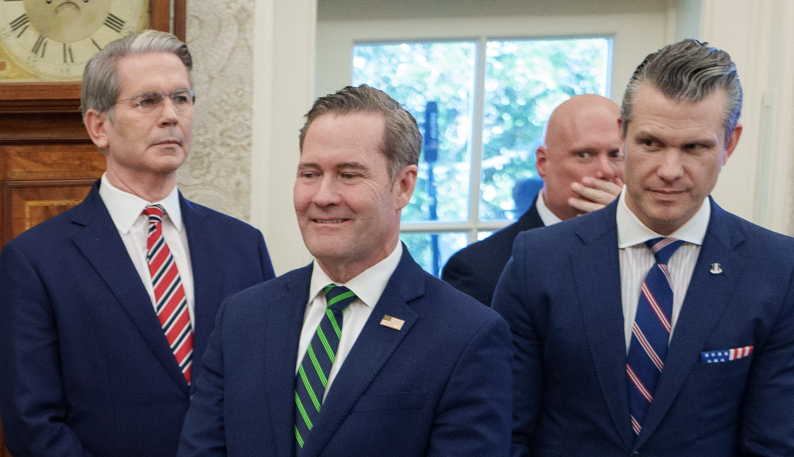
Speaking before the U.N. Security Council, U.S. Ambassador Mike Waltz said the Trump administration views Venezuela as a major security threat linked to transnational terrorism and organized crime. He accused Maduro of relying on sanctioned oil tankers as the primary economic lifeline for what Washington calls an illegitimate regime. According to the U.S., proceeds from Venezuelan crude exports help fund Cartel de los Soles, a group recently designated by Washington as a foreign terrorist organization for its alleged role in drug trafficking into the United States.
The U.S. has significantly increased its military presence in the Caribbean and along the Pacific coast of Latin America. President Donald Trump recently announced a blockade on vessels subject to U.S. sanctions, reinforcing a strategy that includes maritime interdictions. This month alone, the U.S. Coast Guard intercepted two tankers carrying Venezuelan oil in the Caribbean Sea and is pursuing a third vessel that was approaching Venezuela’s coastline.
Russia strongly criticized the U.S. approach, warning that such intervention could become a model for future acts of force against other Latin American nations. Russian Ambassador Vassily Nebenzia cited a U.S. strategy document outlining Washington’s intent to reassert dominance in the Western Hemisphere. China echoed concerns, urging the United States to halt its actions and avoid further escalation.
Venezuela, supported by Russia and China, requested the Security Council meeting, arguing that U.S. actions violate international law. Venezuelan Ambassador Samuel Moncada rejected Washington’s claims of self-defense under Article 51 of the U.N. Charter, stating there is no armed conflict in the Caribbean and accusing the U.S. of being the true source of regional instability.
As diplomatic tensions intensify, the standoff highlights deep divisions over sanctions, sovereignty, and security in the Western Hemisphere, with Venezuela at the center of a growing geopolitical confrontation.