


 BOJ Set for Rate Hike as Inflation and Yen Pressure Mount
  Aztec Revives zk.money for Private Ethereum Payments
  Gold Cracks Below $4150 as Hawkish Fed Sparks Yield Surge — Bears Target $4000 if $4100 Support Gives Way
  RBA Set for September Rate Hike as Inflation Stays High
  Strategy Buys 1,665 Bitcoin as BTC Holdings Reach 847,666
  Cboe Extends SPX Options Deal, Eyes Tokenized Contracts
  RBI Uses $10 Billion Currency Swaps to Drain Excess Rupee Liquidity
  Central Banks Could Buy 20,000 Tonnes of Gold: BofA
  Grayscale Sees Zcash Gaining Market Share Against Bitcoin
  Fed Unveils Stablecoin Rules Under GENIUS Act
  Morgan Stanley Launches Digital Asset Lab for Stablecoins and Tokenization
  Global Derivatives Monitor: BTC & ETH Options & Futures Matrix


 Add as a preferred source on Google
Fears that Chinese growth is weakening, dragging the global economy with it, are hammering commodities and world stock markets. Global stock markets extended broad based sell-off, with Chinese equities rout exacerbating the pain along with plummeting oil prices. Asian stocks slumped to 3-year lows on Monday.
"Markets are panicking. Things are starting look like the Asian financial crisis in the late 1990s. Speculators are selling assets that seem the most vulnerable," said Takako Masai, the head of research at Shinsei Bank in Tokyo.
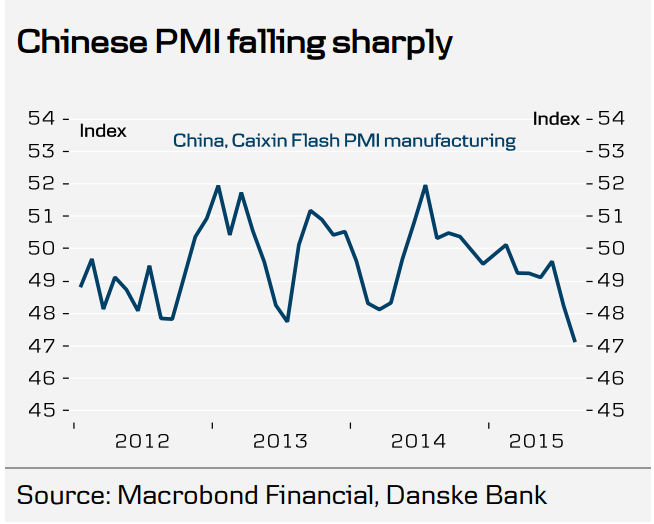
Chinese PMI went from bad to worse in August, down from 48.2 to 47.1, the lowest level since 2009, showing a clear deterioration in the economy. It highlights the risk that the negative effects of the equity market plunge have been underestimated and companies and consumers are hitting the brakes.
Developments in China will continue to demand attention this week. Markets will be watching for China's next move as signs of a slowdown in the world's second-largest economy stack up, raising expectations that the PBoC will act to stoke growth.
"It will be all eyes on the Chinese authorities for any further policy support steps, alongside the People's Bank of China yuan fixings and trading swings," analysts at Investec Economics said in a note to clients.
Further interest rate cuts and a reduction in the reserve requirement ratio are the likely response. A challenge for the PboC is that the intervention to keep the CNY from depreciating too much has put upward pressure on money-market rates. For this reason we believe the PBoC is likely to cut reserve requirement ratio soon.
"We continue to look for one benchmark rate cut of 25bp in Q3 and one to two RRR cuts of 50bp each in H2 2015, depending on liquidity conditions. These should support the real estate sector and growth stabilisation," Barclays said in a note to clients.
China's yuan weakened against the dollar on Monday. Spot market CNY opened at 6.3897 per dollar and was changing hands at 6.3978 at midday, off an intraday low of 6.3994 but was still 0.14 percent weaker than the previous close. Offshore yuan CNH was trading 1.04 percent down from the onshore spot at 6.4648 per dollar.

- News

- Economy

- Central Banks
- Investing
- Research
- Roundups
- Digital Currency
- Insights
- Technical Analysis
- Technology
- Business
- Law
- Health
- Nature
- Fintech
- Science
- Topic
- Opinions
- ©Econometrics LLC . All Rights Reserved.
Weak Chinese data adds pressure on PBoC, policy easing moves look highly likely this week
Monday, August 24, 2015 10:18 AM UTC
Editor's Picks



- Market Data
Most Popular




