

The 2019 federal election results suggested a majority of Canadians preferred a minority government, but the one they got was different than the one they voted for.
The Liberal Party won what can be described as a “stable minority” with barely a third of the total votes while the NDP and Greens elected far fewer MPs than their share of the vote. As in past elections, our first-past-the-post electoral system distorted the electoral preferences of Canadians.
Canada pays a price for this distortion. Not only is the will of the people not reflected in our Parliament, but certain regions — such as Alberta, where 30 per cent of the population didn’t vote Conservative — will not be represented in government at all. In a proportional representation (PR) electoral system, the Liberals would have won 10 seats in the three Prairie provinces, and the NDP as many as nine.
The distortions in our voting system produce apathy among some voters. No doubt, there are other reasons why people don’t vote, but one is that they don’t feel that their vote will make any difference. In a first-past-the-post system, if you are an NDP voter in a riding where the overall NDP vote is marginal (say, less than 10 per cent), you may feel like voting doesn’t count for much.
The current electoral system also incentivizes “strategic voting,” especially on the political left, in order to prevent a Conservative Party breakthrough. This too is part of our voting system’s distortions.
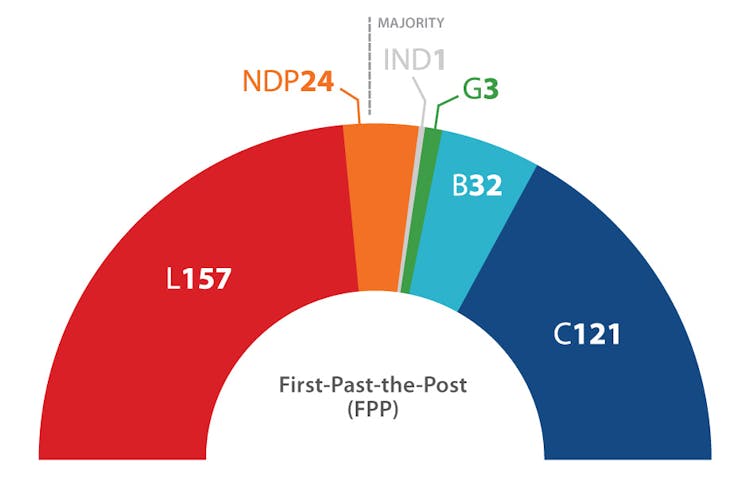
Canada’s 2019 national election results. Rebecca Baxter and Matthew Hayes, Author provided
The voting results in 2019 using the first-past-the-post system distorted the Liberals’ results over much of the country. If we went only by national voter turnout, results from the election would look very different.
Supposing a five per cent cut-off for parties to be represented in the House of Commons, the seat totals using the total national vote would look like something close to this:
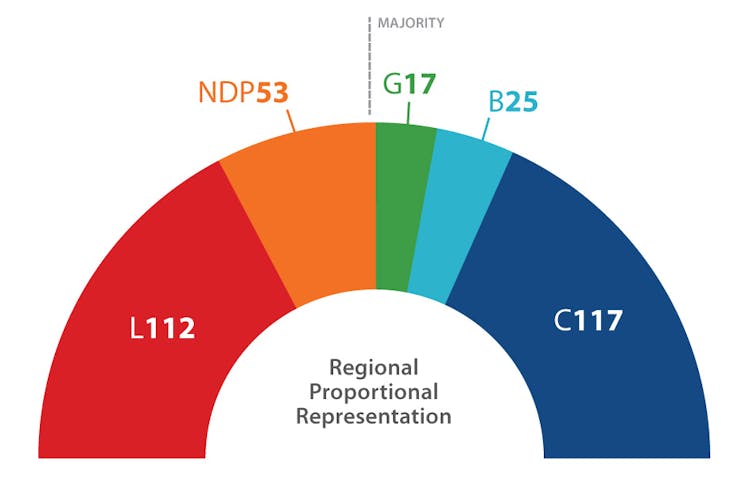
A fictional scenario of Canada’s election result - with Regional Proportional Representation. Rebecca Baxter and Matthew Hayes, Author provided
In this scenario, eight remaining seats representing just over two per cent of the population who voted for other parties would have to be apportioned to the main parties, using an agreed-upon formula to make fractional numbers into whole seats. The numbers in the chart above round each party’s seat total to the nearest whole seat, but that leaves several parties with over- and under-votes that are fractional and not representative.
There are several formulas for resolving this, the most widely used is what’s known as the D’Hondt method.
BBC journalists explain the D'Hondt formula for proportional representation for the UK.
Regional differences
In Canada, one could reasonably object that a national proportional representation system would distort regional differences. This might dilute strong regional parties, most obviously the Bloc Québécois, but possibly also the Conservatives, whose Western power base would be diluted by weaker support elsewhere.
Taking the election results and breaking them down by region that would each retain the same number of regional seats chosen proportionally (Atlantic Canada 32; Quebec 78; Ontario 121; Prairies 62; BC 42; the North 3), the results would look something like this:
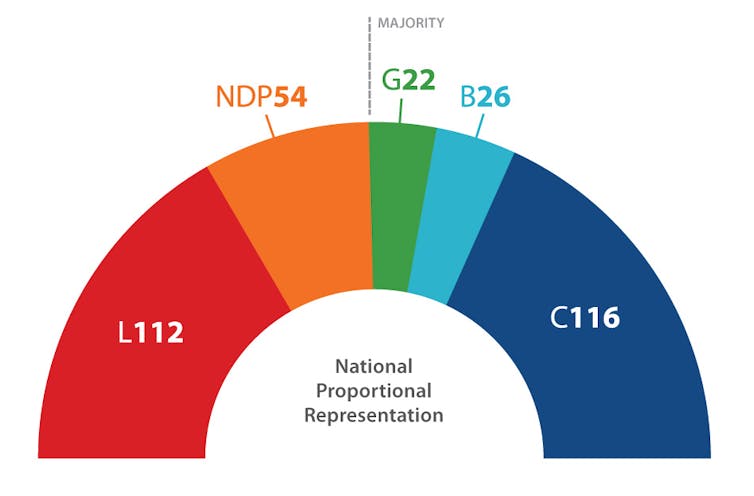
A fictional scenario of Canada’s election result - with National Proportional Representation. Rebecca Baxter and Matthew Hayes, Author provided
That would mean reapportioning about 14 other seats, five of which represent Green votes in Québec and on the Prairies, where the Greens would have failed to make the five per cent cut-off for representation (they would have made a three per cent cut off in both regions).
Lower Conservative numbers in the Prairies are made up through higher representation in the Maritimes and Québec, where the Conservative Party would draw part of its caucus, giving it a much more national base.
Prime Minister Justin Trudeau’s announcement that he will govern without a coalition partner, and therefore not have to compromise with any other parties, is precisely what Canadians voted against when they elected a minority Parliament.
With a proportional representation electoral system, Parliament would require a lot more co-operation among major parties to pass legislation and stave off confidence votes. This could also make Parliament more stable and less divisive.
Electing MPs to reflect our values
As the outgoing prime minister, Trudeau would still have had the right to try to form a coalition government, but his options would have been more limited. The NDP would have had a much stronger voice, technically able to govern with either the Conservatives or Liberals.
A slightly different vote, however, might have produced a Parliament where more than two parties would have had to work together. It would have also limited the overall size of the Bloc Québécois without completely sidelining them or Québec representatives in any governing coalition.
Minority parliaments require the large national parties to co-operate in order to turn electoral success into parliamentary influence — a feature singularly missing from our current first-past-the-post system. Parliamentary leaders best able to be diplomatic and create relationships across party lines would be the true power brokers — not the PMO alone — of the new parliamentary system.
There are other advantages to moving to proportional representation. The use of party lists would make it easier for parties to represent women, ethnic minorities and other under-represented groups. It would also enable them to draw MPs from a deeper talent pool, more representative of a party’s national support.
Rather than distorting our vote, we might be able to elect parliaments that reflects who we are.
A version of this article was first posted in the ‘NB Media Co-op.’

