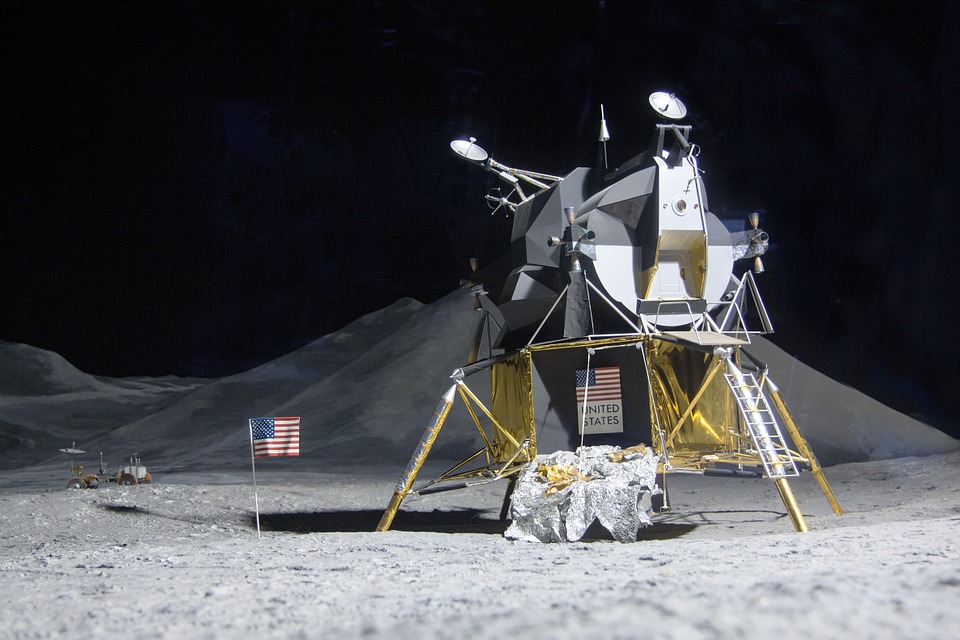
Over 50 years ago, three astronauts, Neil Armstrong, Buzz Aldrin, and Michael Collins, made history as they won the space race against the Soviet Union. Footage from an interview weeks after the historic mission, Collins recalled being unable to see any stars while in orbit.
Weeks after the historic trip to the Moon, Armstrong, Aldrin, and Collins spoke about their mission in a press conference. When asked what the sky looked like from the surface of the moon, Armstrong explained that they could not be able to see the stars from the surface or even on the daylight side of the moon. “I don’t recall, during the period of time we were photographing, what stars we could see,” said Armstrong.
Collins then replied that he did not remember seeing any stars, as he was piloting the Command Module for 21 hours while Armstrong and Aldrin did their experiments on the lunar surface. “I don’t remember seeing any,” said Collins.
Over time, conspiracy theories circulated that the moon landing was faked as there were no stars seen in the photos. The reason that there are no stars in the photos is because the light from the Sun out in space is as bright as the Sun that reaches the Earth’s surface.
Aldrin was then asked what the surface of the moon was like to walk on. “In rather flat regions, the footprint would penetrate perhaps a half-inch, sometimes only a quarter...In other regions, near the edges of these craters we could find the foot would sink maybe two, three, possibly four inches,” said Aldrin.
The historic Apollo 11 mission was eight years in the making in a combined effort of hundreds of scientists and engineers. Among those scientists and engineers was one Werner von Braun, also known as Wernher von Braun, a Junior SS officer from Nazi Germany. Following the Second World War, Von Braun and his team of 118 scientists in a facility in the Baltic sea surrendered to the first US soldiers they could find.
As the Allied Forces obtained a list of scientists that they wanted to recruit to work on their top-secret missions, they brought in von Braun as an aeronautics pioneer to the United States instead of a war criminal. Following the success of the first American satellite, Explorer I, von Braun was made NASA’s top engineer and was tasked to design the Saturn V rocket that would bring Armstrong, Aldrin, and Collins into space.