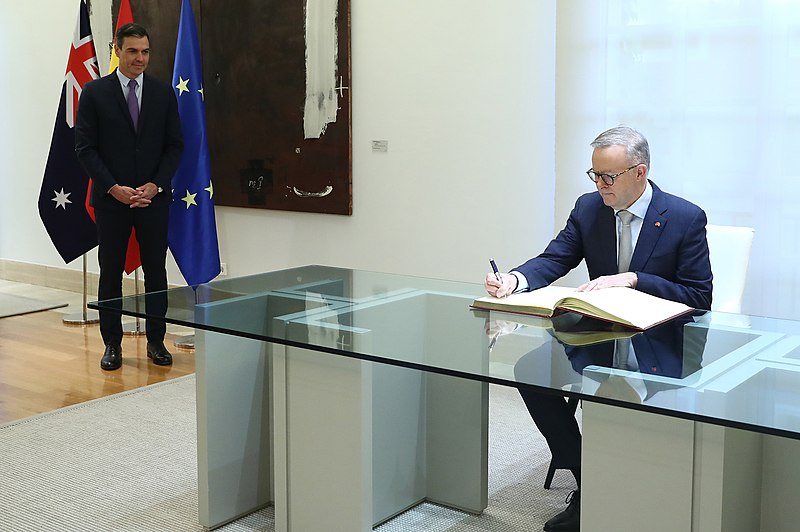
Australian Prime Minister Anthony Albanese marked his first 100 days as the country’s leader and the Labor Party’s government this week. Albanese said his government was focusing on reforming the workplace as the country recovers from the COVID-19 pandemic.
In his speech at Canberra to mark 100 days of being in office, Albanese said pro-worker and pro-business was his government’s main agenda for growth.
This comes as the government will be hosting a jobs summit to help bring together employer and union groups to talk about wage growth, productivity, workplace reform, and migration.
“The biggest single outcome I am hoping for is the beginning of a culture of cooperation,” Albanese told the National Press Club Monday.
Albanese said skills shortages posed a challenge to the country’s economy and that it was a mistake for the previous government to tell temporary visa holders to leave Australia during the pandemic just as the borders were closed.
Albanese also said that aside from discussing migration intake, his government plans to look into “creating more paths to permanent migration” to get foreign workers back in areas such as nursing and engineering, among others.
Shoring up the economy to provide families and businesses with much-needed security was a priority for Albanese’s government. Albanese noted that the pandemic was a challenge that the country was not prepared for.
“Australia is already in the ‘recovery’ phase – and that’s presenting its own economic challenges including significant and unpredictable supply and demand imbalances which are driving up costs, for businesses and families,” said Albanese.
Thursday last week, the Pentagon announced that the State Department has approved a potential sale of military helicopters and related equipment to Australia as it seeks to increase its presence in the Indo-Pacific region.
Australia requested to buy 40 UH-60M Black Hawk helicopters with Lockheed Martin Corp. as the principal contractor, according to the Pentagon.
The latest approval follows another sale to Australia back in May when the State Department approved the sale of mobile rocket launchers, along with several weapons in a sale to allies worth $3.1 billion.
The sales in recent months came at a time when governments are looking to invest in weapons systems in light of Russia’s invasion of Ukraine.