


 RBI Raises Repo Rate to 5.50% in Hawkish Shift on Inflation Risks
  Asian Stocks Mixed as OpenAI Revenue Concerns Hit Chipmakers
  Deere, CNH and AGCO Stocks Fall as FTC Launches Farm Equipment Probe
  Iran Refuses to Halt Uranium Enrichment Amid US Nuclear Demands
  Deutsche Bank CEO Urges Faster German Economic Reforms
  Gold Prices Hit One-Week High as Oil Falls, Fed Rate Outlook Weighed
  Fed Minutes Signal Another Rate Hike by Year-End
  Bangladesh GDP Growth Accelerates to 4.6% on Industrial Rebound
  Trump Secures Russian Diesel Deal as US Fuel Prices Surge


 Add as a preferred source on Google
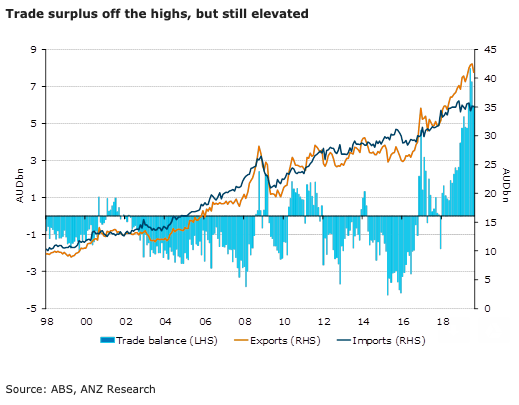
Australia’s trade surplus in August fell in line with expectations, as export values dipped in the month and imports were broadly steady. The main drag on exports was from non-rural goods, reflecting the drop-off in iron ore prices. Service exports rose during the month and should continue to grow, helped by the weaker AUD, ANZ Research reported.
The monthly trade surplus dipped to AUD5.9 billion, still high but down from July’s revised surplus of AUD7.3 billion. Underlying this was a 3.4 percent m/m decline in exports, while imports were down 0.4 percent m/m.
Total resource exports fell 5.5 percent m/m in August, led by a 10 percent decline in metal ores and minerals, while coal fell 4 percent. The volatile non-monetary gold component declined 22 percent (an AUD601 million fall). Manufacturing goods exports were down 2.3 percent but rural goods increased 1.4 percent, helped by 5 percent increases in both cereals and meat. Service exports rose 0.6 percent, as travel increased 0.7 percent.
Capital goods imports dropped 1.9 percent m/m, with a 5.4 percent fall in machinery and equipment more than offsetting 4.2 percent and 26.2 percent rises in transport equipment and civil aircraft, respectively.
Consumption goods imports fell 0.9 percent as household electrical items dropped 3.2 percent. Intermediate goods imports, excluding fuel, fell 3.6 percent as parts for capital goods declined 3 percent. Fuel imports declined 7.2 percent. Service imports rose 1.9 percent as travel rose 0.8 percent.
"Overall, the peak in the trade surplus is in the rear view mirror. However, we expect surpluses to continue, albeit diminishing slowly over time, as the boost from the prior surge in iron ore prices fades," the report further commented.







