


 BOJ Raises Interest Rate to 31-Year High as Yen Weakens
  U.S. Banks Report Strong Q4 Profits Amid Investment Banking Surge
  Mexico's Undervalued Equity Market Offers Long-Term Investment Potential
  Indonesia Surprises Markets with Interest Rate Cut Amid Currency Pressure
  2025 Market Outlook: Key January Events to Watch
  Moldova Criticizes Russia Amid Transdniestria Energy Crisis
  Fed’s Hammack Says More Data Needed Before Next Rate Move
  Moody's Upgrades Argentina's Credit Rating Amid Economic Reforms
  Lithium Market Poised for Recovery Amid Supply Cuts and Rising Demand
  Fed’s Williams Signals One More Rate Hike Before Year-End
  Trump Demands Powell Resign Over Fed Renovation Cost Overruns
  RBA Says ASX Still Falls Short on Governance and Risk Controls
  RBI Raises Repo Rate to 5.50% in Hawkish Shift on Inflation Risks
  UBS Predicts Potential Fed Rate Cut Amid Strong US Economic Data


 Add as a preferred source on Google
Bank of England left its monetary policy unchanged but the dissenting votes for an immediate 25bps hike, from the current Bank Rate of 0.50%, rose from two to three (Chief Economist Haldane, who has broken ranks verbally before, joined known hawks McCafferty and Saunders). In addition, due to the generally lower levels of rates, the Bank lowered the rate at which they would consider altering their asset holdings to 1.5% (from 2.0%). That remains a distant prospect given that their outlined path of three 25bps rises is over the next three years. The statement and minutes confirmed their prior view that the economy was recovering as projected and that 1Q weakness was temporary.
Over 2018, we see scope for some further underperformance from NZD, as we expect ongoing confirmation that the RBNZ can credibly lag policy normalization in the G3. Evidence that real assets (equities, housing) are threatened by late cycle growth dynamics and government intervention would add further weight to this story. NZDUSD is expected to depreciate to 0.66 by 2Q’19.
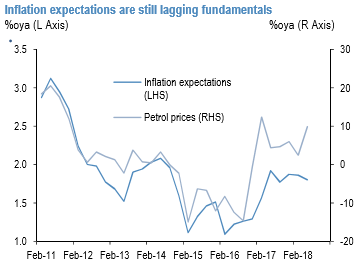
RBNZ Governor Orr’s first MPS maintained the low for long policy guidance, with an evenly balanced outlook for the near-term. The Governor stated the next move is equally likely to be up or down and has placed significant weight on the fact that inflation expectations have become more backward-looking, which slows the recovery from several years of below-target outcomes. Such headwinds were highlighted in the most recent RBNZ expectations survey, where 1Y forward expectations remain lower than would be expected, in the context of rising oil prices (refer 1st chart).
NZD faces domestic headwinds to local rates that are only now being fully appreciated. Growth has weakened, the central bank’s inflation forecasts have been revised materially lower, net immigration is slowing and business confidence has fallen significantly since the change of government.
While the Aussie has been one of the worst performers in the broad-based US dollar rally since the June FOMC and ECB meetings. But the RBA should also be optimistic on Australia’s growth outlook in its Aug statement. Courtesy: JPM & Westpac
Currency Strength Index: FxWirePro's hourly NZD spot index is inching towards -26 levels (bearish), while hourly USD spot index was at -110 (bearish), GBP flashes at 139 (bullish) and AUD at 35 (bullish) while articulating at 07:32 GMT. For more details on the index, please refer below weblink:
http://www.fxwirepro.com/currencyindex.
FxWirePro launches Absolute Return Managed Program. For more details, visit:







