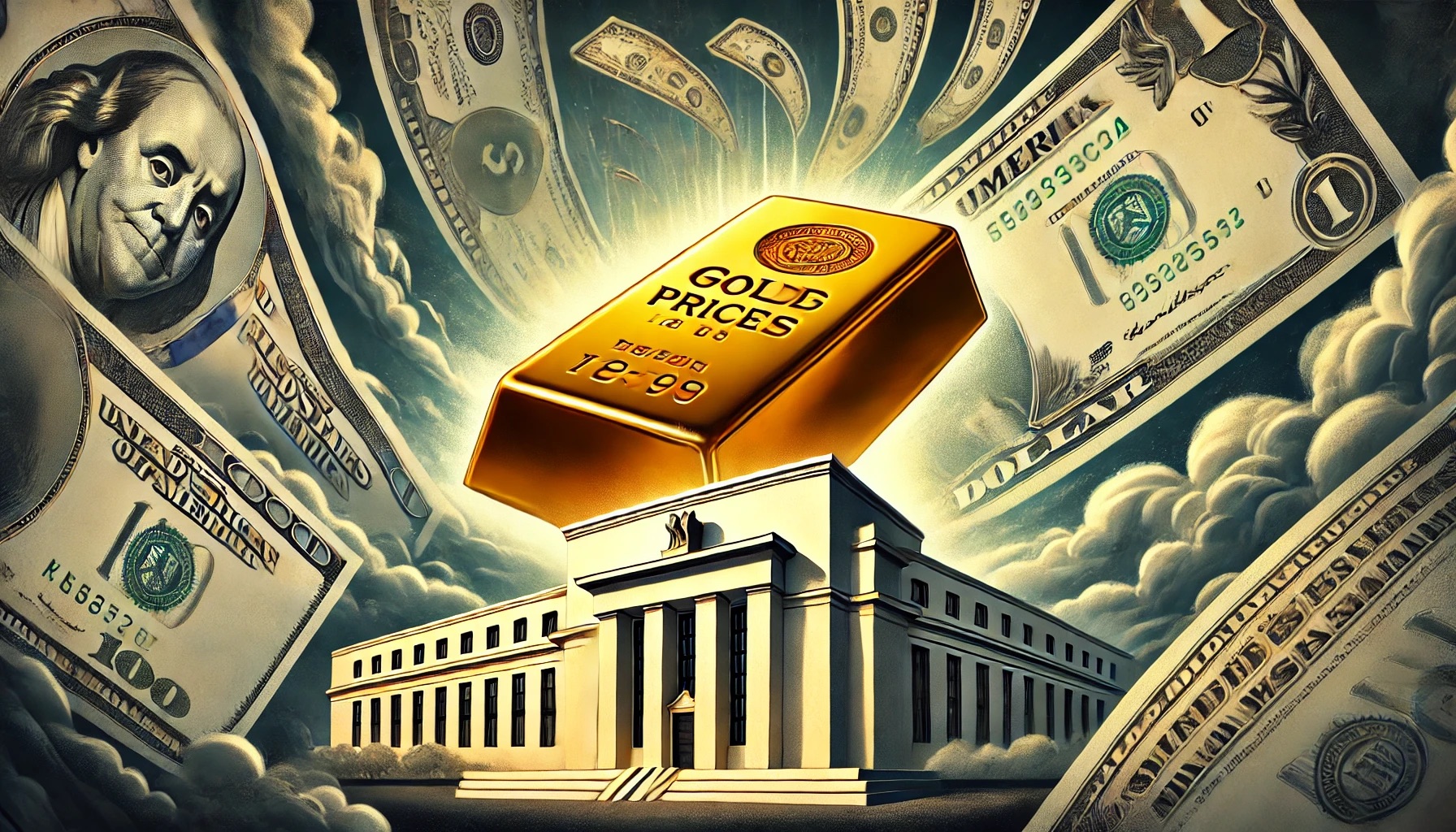
Gold prices inched higher in Asian markets Tuesday, with spot gold gaining 0.2 percent, while futures added 0.1%. The precious metal's upward movement was limited as the Federal Reserve's hawkish policy reinforced dollar strength, dampening demand for the non-yielding asset.
Gold Prices Begin Week with Tepid Gains Amid Fed’s Hawkish Stance
On Tuesday, in Asian trade, gold prices rose little, continuing their lackluster performance, as investors remained wary of the rising dollar after the U.S. Federal Reserve's hawkish stance.
Also, because the trading week will be shorter than usual because of the Christmas vacation, traders were hesitant to place big bets.
The price of spot gold rose 0.2% to $2,617.22 per ounce as of 21:46 ET (02:46 GMT), while the price of gold futures expiring in February rose 0.1% to $2,631.89 per ounce, Investing.com reports.
Fed’s Hawkish Stance Weighs on Investor Sentiment
Uncertainty regarding the metal's future led to a 1% loss in the previous week, and Monday saw the yellow metal edge up 0.3%, indicating that uncertainty.
On Wednesday, gold prices fell to their lowest point in a month as the Federal Reserve meeting signaled that rates will stay higher for a longer duration following Wednesday's reduction.
As investors continued to weigh the ramifications of the Federal Reserve's rate forecast, prices remained low and never fully recovered.
Because gold's attractiveness relative to interest-bearing assets like bonds grows when the opportunity cost of holding it rises in response to higher interest rates, gold's price falls.
Dollar Strength Continues to Pressure Gold Prices
With the economy showing signs of resiliency and inflation remaining elevated, traders are now projecting just two quarter-point cuts for 2025. This is in contrast to the four rate decreases that were anticipated prior to the Fed meeting.
The U.S. dollar gained momentum again after the Fed's hawkish move because of the positive effect of rising interest rates on dollar-denominated assets' attractiveness.
During Tuesday's Asian trading, the US Dollar Index increased by 0.1% and continued to trade close to the two-year high it hit last week.
Gold prices tend to rise when the dollar strengthens because customers using foreign currencies have to pay more for the yellow metal.
There was a noticeable lack of other valuable metals. At $951.90/oz, platinum futures were up 0.1 percent, while silver futures were up 0.2 percent, at $30.062/oz.
Copper Prices Muted by Seasonal Sluggishness
As the red metal was pulled down by a strong dollar, copper prices remained muted and fluctuated between narrow bands on Tuesday.
The seasonal slowdown in industrial production and construction projects, which analysts said was to blame for copper's decline, is a common occurrence as companies and projects wind down for the year and get ready for the holidays.
The London Metal Exchange's benchmark copper futures remained mostly unchanged at $8,940.50/ton, while the one-month copper futures remained stable at $4.0905/lb.