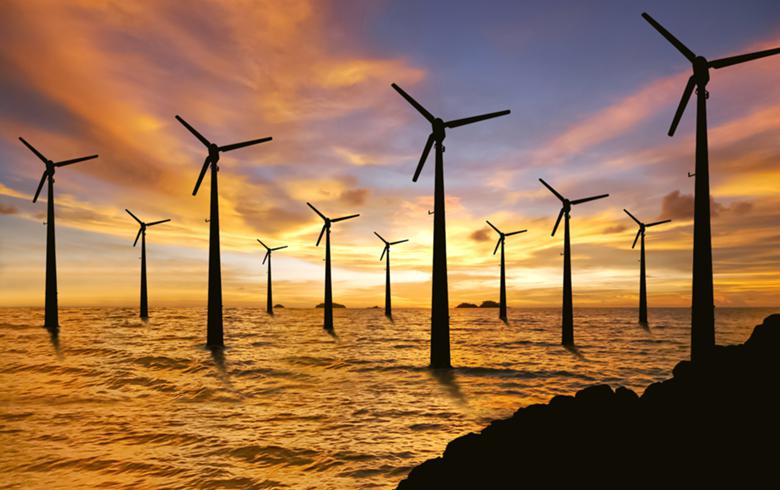
Japan aims to generate up to 45 gigawatts of power annually through offshore wind power in 2040 to achieve net-zero emissions of carbon dioxide by 2050, which could make it the world's third-largest generator of such power.
The plan was agreed upon by officials from the economy and land ministries and the private sector.
The target is equivalent to the electricity output of 45 nuclear reactors.
Under the plan, Japan will first increase offshore wind power generation to 10 gigawatts by 2030, raising it to between 30 gigawatts and 45 gigawatts in 2040.
Japan currently generates just 20,000 kilowatts through offshore wind farms and is not even among the top 10 generators using that power source.
In fiscal 2018, only 17 percent of Japan's total power generation source came from renewables. Fossil fuels such as coal and liquefied natural gas accounted for 77 percent, while nuclear power was at 6 percent.
The government will provide surveys on wind movements and geology of seabeds to facilitate market entry by new operators.
Electricity generation from offshore wind power is expected to get cheaper than that of fire power by 2030 to 2035.
According to a projection by the International Energy Agency, the EU aims to produce 127 gigawatts as China targets 107 gigawatts in 2024.