
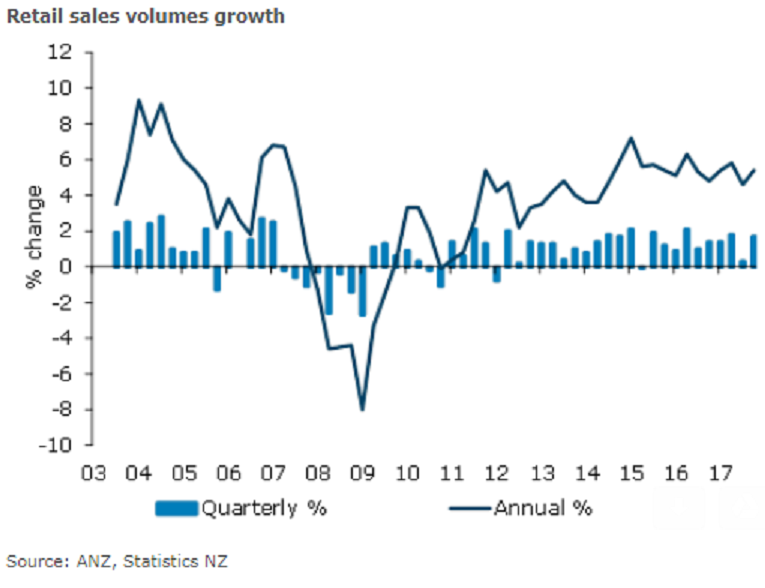
New Zealand’s retail sales volumes were stronger than expected in Q4, with retail discounting, especially across big-ticket items – continuing to have a key influence. Retail sales volumes rose solidly (beating market expectations) in Q4, lifting 1.7 percent q/q. This follows modest (but upwardly revised) growth of 0.3 percent q/q in Q3. In per capita terms, real spending rose 1.1 percent q/q, which easily reverses the small dip experienced in Q3 (which was only the second fall in the past five years).
Eleven of the 15 retail industries saw higher sales volumes in the quarter. There was especially strong growth in food and beverage services (+3.7 percent q/q), which could be a reflection of the unseasonably warm weather over the latter part of the quarter. Apparel spending also rose strongly for the second consecutive quarter (+4.0 percent q/q). But it doesn’t appear to have been a tourism-related story, with accommodation spending down 2.3 percent q/q.
After a mixed Q3, motor vehicle sales rose 2.1 percent q/q and furniture and floor coverings lifted 3.6 percent q/q. There were also solid gains in electrical and electronic goods (2.6 percent q/q). Interestingly, the implied prices for all of these components fell in the quarter, highlighting the ongoing theme of price competition.
Further, nominal spending rose only 0.5 percent q/q in both Auckland and Wellington, but it was strong in the likes of the Waikato, Bay of Plenty and Gisborne. The labour market is strong, and wage growth is expected to tick higher. Interest rates remain low and competitive price pressures should persist.

