
Data released by Norway's real estate industry association last week showed that Norwegian seasonally adjusted housing prices fell by 0.7 percent in May from April in a further sign the market was cooling off from a rapid rise in recent years. Data showed that house prices rose by 8.3 percent y/y in May, down from 10.7 percent in April and from a decade-high 13 percent in February. Unadjusted prices fell by 1.1 percent in May from April, the weakest nominal outcome for a single month since October of 2015.
The Norwegian government at the start of the year imposed tougher banking regulations to curb mortgage lending an help limit the growth in property prices. In addition, housing starts have risen significantly aiding cool the property market. Norges Bank probably still see the housing market as an argument against cutting rates, as household credit growth is still very high. Household credit growth was 6.5 percent y/y in April, just 0.2pp slower than in March.
"We stick to our view of unchanged policy rates in June and going forward and believe inflation has to come further down before rates are cut. A few months of falling house prices will not be enough to trigger a rate cut either, but a large fall and indications it will hit the real economy through lower housing investment and private consumption may. But we are far from that scenario at the moment," said DNB Bank in a report to clients.
Economic data out of Norway has been mixed during the last weeks. Improvement was seen in capacity utilization and unemployment fell, while inflation remained below Norges Bank’s projection from March. Registered unemployment (unadjusted) fell 0.2 percentage points to 2.6 percent in May.
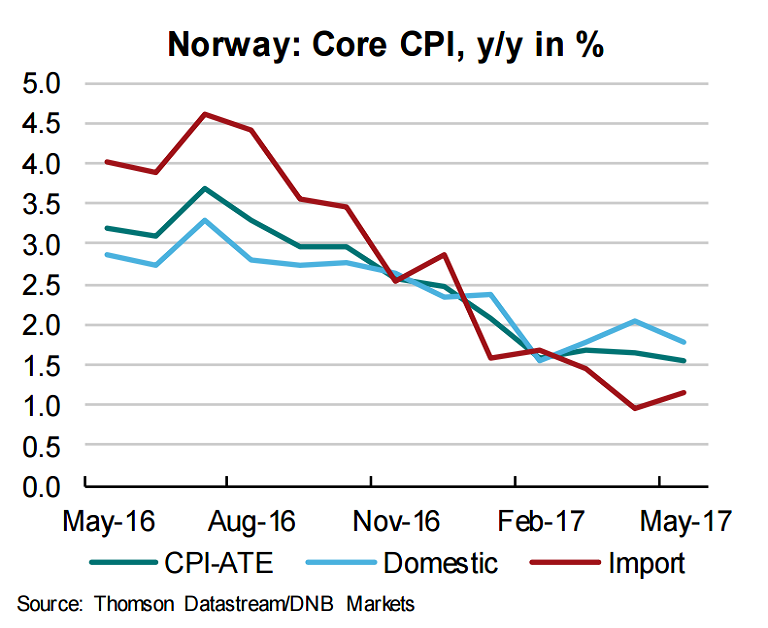
Norway's inflation rate fell further below its target level in May, despite the end of Easter sales and the first monthly increase in fuel prices for four months. Consumer prices were 2.1 percent higher than the same time last year, compared to the previous month’s 2.2 percent rise. Core inflation (CPI-ATE) which strips out more volatile factors such as energy prices, was only 1.6 percent. The Norges Bank currently targets a rate of 2.5 percent and has indicated it is unlikely to cut rates to try to stimulate inflation back toward the target.
EUR/NOK was trading at 9.5052 at the time of writing, largely unchanged on the day. The pair remains capped below 5-day MA at 9.5220 and momentum indicators suggest further declines. We see scope for test of 20-DMA at 9.4392. Violation there could see test of trendline at 9.4090.


