


 SpaceX Starlink Restrictions Disrupt Ukraine Military Operations
  Trump Denies Russia and China Are Helping Iran in U.S. Conflict
  Netanyahu Rejects Preemptive Iran Strike Ahead of Israel Election
  US Justice Department Drops Prosecution of Ex-CIA Analyst Sue Mi Terry
  China Warns Taiwan Over South China Sea Coast Guard Incident
  US Condemns China Sanctions on Taiwan Allies Belize and Paraguay
  Zelenskiy Seeks New US Talks to Revive Ukraine-Russia Peace Negotiations
  Trump Warns Houthis Over Attacks, Considers Erdogan Intervention
  FBI Denies Report of Kash Patel’s Russia Visit
  MI5 Warns of Rising Iran, Russia Threats and AI Bioweapon Risks
  Zelenskiy Says Ukraine Received No Warning Before Russian Missile Attack
  IMF Warns US Debt Crisis Needs Fiscal Action, Urges China to Boost Consumption
  China Resumes US Soybean Purchases After Trump-Xi Summit
  Flavio Bolsonaro Backs Brazil’s 40-Hour Workweek Reform Ahead of Runoff
  Italy’s Meloni Warns US-Russia Diesel Deal Could Weaken Ukraine Sanctions
  Elon Musk Donates $366 Million to 2026 US Midterms
  UN Urges Talks on Lebanon Peacekeeping Mission Extension


 Add as a preferred source on Google
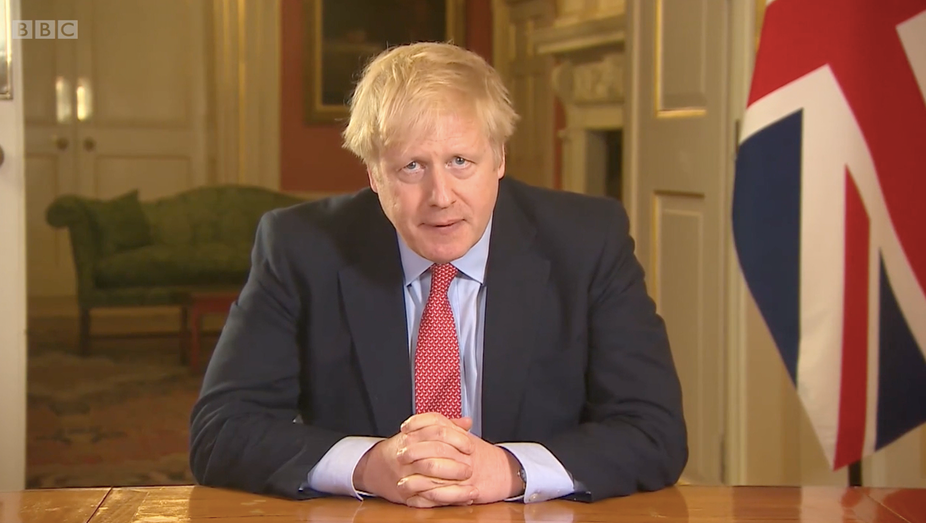

Boris Johnson chose a “day of rest” - Sunday May 10 2020 - to broadcast to UK citizens about the government’s plans for the next stage in its COVID-19 measures. The broadcast comes days after announcements by Angela Merkel in Germany and Emmanuel Macron in Franceof their plans to rollback lockdown.
Why choose Sunday? Johnson attempted to explain why in the most recent Prime Minister’s Questions on Wednesday May 6, when he said:
The reason is very simple. We have to be sure that the data is going to support our ability to do this (coming out of lockdown), but that data is coming in continuously over the next few days.
We will want, if we possibly can, to get going with some of these measures on Monday, and I think it will be a good thing if people have an idea of what is coming the following day.
That is why I think Sunday – the weekend – is the best time to do it, but of course the House will be fully informed and will have the full opportunity to debate and interrogate me or the Government on that matter.
This doesn’t answer the question fully. If a bit more time were needed, why not choose Monday for example? If organisations are literally meant to start on Monday, isn’t Sunday a bit too close?
Why Sunday
For the government a Sunday announcement has several advantages, many of them to do with the news agenda. As a general rule, there is less news on a Sunday and so fewer events to fight with for attention. Making an announcement directly to the public also removes some of the immediate opportunities for opposition politicians to negatively comment on any changes.
But the televised address is just part of the communications package. It is normal for governments, and for that matter oppositions, to selectively brief the press with aspects of a statement or a launch early to get Sunday newspaper front pages. And, as first editions prepared on Saturday evening, that means the Johnson speech can be just one part of a larger communications exercise with messaging throughout the 24-hour news cycle and critics struggling to catch up.
While televised government press conferences and direct addresses by the prime minister are relatively rare in this country (outside the controlled mechanisms of election broadcasts) they are more common elsewhere.
In the US, for example, Franklin D. Roosevelt’s “fireside chats” morphed into a weekly radio address, a tradition continued by many presidents. George Bush, for example, introduced a podcast, while Barack Obama used a weekly video address during his presidential transition period. Donald Trump continued the weekly address via video for the first nine months of his administration, then put it on hiatus.
Here though, the concept of the UK prime minister speaking directly to the nation is less usual and so carries more weight.
Crisis comms
Generally prime ministerial addresses come at times of crisis or highly significant news. They are there to tell us we are “at war with Germany” or that the war with Iraq was starting. Theresa May’s televised address in 2019, ahead of requesting a Brexit extension, was widely seen as misguided – but it is clear she felt she needed to appeal to an audience outside the Commons.
The government’s need to communicate – and the volume of questions coming from all sides – has led to the daily televised press conference, which is an odd mix of direct address, with speakers talking to camera using visual aids, and interactions with journalists.
This in turn has sparked a subset of comments, including those from former Blair communications chief Alastair Campbell and TV presenter and former tabloid editor Piers Morgan, on style, content and delivery. This may lead in turn to pressure to make the “peacetime” Downing Street briefings more visible.
At the moment these are rather behind closed doors and one of them – in pre-COVID times – was even referred to by journalists as the “huddle”. Of course journalists in the lobby (effectively a self-policing group who get special access) have an interest in opportunities beyond the camera’s gaze.
Johnson has a difficult tightrope to walk. His natural presenting style is ebullient and often slips into humour. But these are dark times which call for a serious approach which informs rather than confuses.
His announcements won’t be news for many groups. We already know that draft plans have been circulating business and trade union organisations. And that there have been conversations about what might be possible.
Many organisations will already have been given advance information. So Johnson’s main task is to convince the rest of us and to answer some of those hanging questions about school re-openings, shops, workplaces and travel.







