


 BOJ Raises Interest Rate to 31-Year High as Yen Weakens
  RBI Uses $10 Billion Currency Swaps to Drain Excess Rupee Liquidity
  Yen Sinks as BOJ Rate Hike Fails to Impress Markets
  European Stocks Rally on Chinese Growth and Mining Merger Speculation
  Fed Unveils Stablecoin Rules Under GENIUS Act
  Moldova Criticizes Russia Amid Transdniestria Energy Crisis
  2025 Market Outlook: Key January Events to Watch
  UBS Predicts Potential Fed Rate Cut Amid Strong US Economic Data
  US Futures Rise as Investors Eye Earnings, Inflation Data, and Wildfire Impacts
  China’s Growth Faces Structural Challenges Amid Doubts Over Data
  Gold Prices Slide as Rate Cut Prospects Diminish; Copper Gains on China Stimulus Hopes
  US Gas Market Poised for Supercycle: Bernstein Analysts
  ECB May Stop Rate Hikes After December, Capital Economics Says
  Fed’s Logan Signals 50 Basis Points More in Rate Hikes


 Add as a preferred source on Google
Federal Reserve and Bank of Japan are the two G7 central banks scheduled for their monetary policies this week and for the next week. Ahead of the Fed tomorrow, the US yields have taken back some of last week’s strong rise, seeing USDJPY reverse sharply from 110 to 108 again, while the broader USD looks like it could develop a stronger corrective rebound.
We expect the yen to remain weak as the corona crisis continues to ebb. But the depreciation potential is limited, since the BoJ's expansionary measures, which are far less aggressive than those of other central banks, are dampening the inflation outlook.
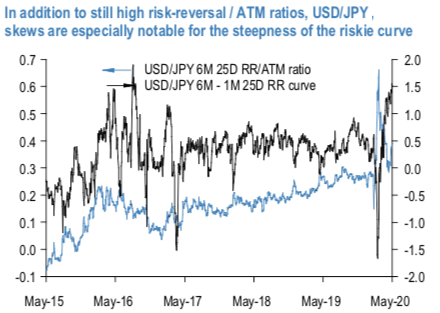
USDJPY is no exception to the general theme of rich risk-reversals relative to ATM vols across G7 surfaces; the Yen skew curve also screens extremely steep. We flagged the elevated RR/ATM ratio set-up last week as a key rationale for initiating a delta-hedged ratio USDJPY put spread to scalp smile theta, a structure that also dovetails with our Yen strategists' view of gradual currency strength in coming months as Japan’s post-COVID-19 return to deflation amid tame BoJ easing relative to the Fed increases JPY’s real yield edge over USD. A related notable observation regarding JPY skews is the extreme steepness of the risk-reversal curve (refer 1st chart), which renders the belly of the curve (6M) a relatively better location for medium-term skew shorts than shorter-expiries, and also has the happy side-effect of providing some insulation against erratic gamma spikes that can never be ruled out in the current virus-infected and politically fraught market environment.
No discussion of Yen options today can be complete without highlighting the dramatic collapse of front-end vols; USDJPY put spreads/ digitals are at all-time lows in premium. The 10% pt. peak-to-current decline in 3M USDJPY ATM vol over the past two months only has two historical precedents – the Asian Financial Crisis ‘97/’98 and GFC’08; the difference is that peak vol levels were materially higher on both occasions, though this does not render the current correction "wrong" as it comes on the heels of an equally spectacular crash in realized vol as well, with USDJPY spot tuck in a tight 106 – 108 range for much of the past two months. Per the strategic Yen view outlined above, we do not hold out great hope that this state of affairs will change anytime soon barring an unexpected shock on the US/China tensions front. But the steep risk- reversal /ATM ratio set-up that such a collapse in vols has spawned is responsible for depressing prices of USD put/JPY call spread and digital options to the lowest on record (refer 2nd chart). Macro investors looking to position for a multi-month grind lower in USDJPY or portfolio hedgers looking for low-premium Yen protection could do worse than buying such highly geared, limited upside structures. Courtesy: JPM







