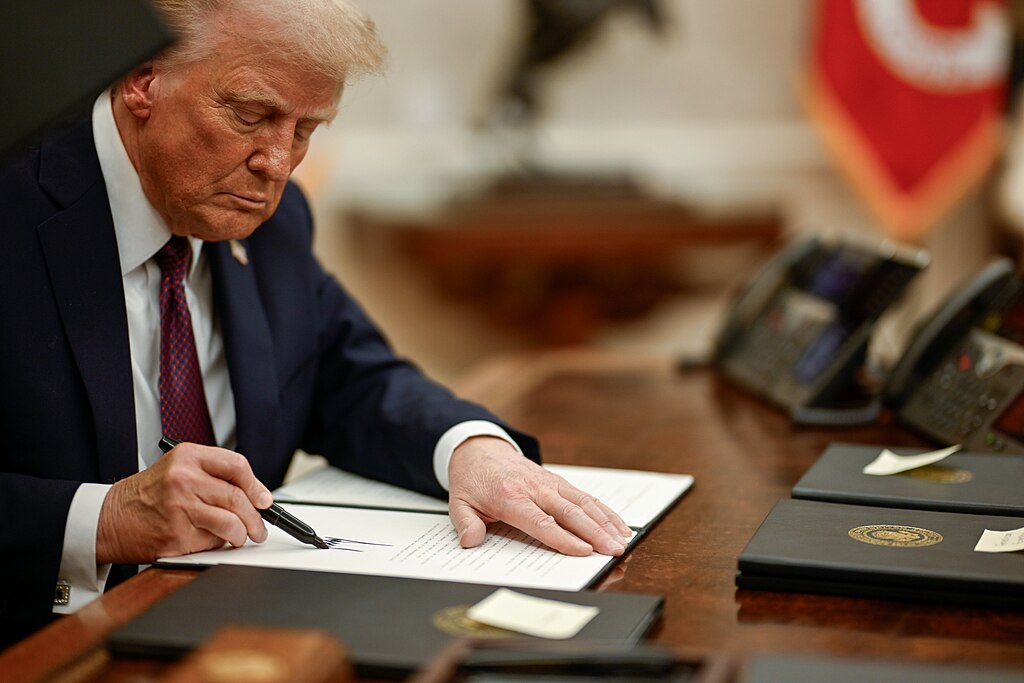
U.S. President Donald Trump signed a new executive order Thursday to enhance law enforcement presence and ease concealed carry permit access in Washington, D.C. The move comes amid his ongoing criticism of crime, homelessness, and federal workforce reductions in the nation’s capital.
The order establishes a federal task force to increase police deployment, tighten pre-trial detention policies, and crack down on subway fare evasion. It also aims to speed up concealed carry license applications for “law-abiding citizens.” Currently, residents and non-residents over 21 can apply for a concealed carry permit after completing a firearms training course, according to the U.S. Concealed Carry Association.
Trump’s administration described the order as an effort to make D.C. “the pride of every American.” His concerns have long centered on homelessness and crime in the city, often criticizing what he sees as deteriorating urban conditions.
Despite his claims, crime data shows a downward trend. In 2024, violent crime dropped 35% compared to 2023, and overall crime fell 15%, according to the D.C. Police Department. So far in 2025, violent crime is down 27%, and overall crime is 9% lower than in 2024. However, homicides have risen, with 30 reported as of early March—an 11% increase year-over-year.
D.C. Mayor Muriel Bowser responded critically, stating that Trump’s federal layoffs are harming the city’s ability to thrive. “You don’t make a city beautiful by gutting its workforce or leaving buildings vacant,” she told NPR. Bowser noted progress in clearing homeless encampments but said Trump’s expectations are unrealistic.
The executive order also includes provisions to deport undocumented migrants, though specifics remain unclear.