


 Trump Denies Russia and China Are Helping Iran in U.S. Conflict
  Flavio Bolsonaro Backs Brazil’s 40-Hour Workweek Reform Ahead of Runoff
  Kim Jong Un Showcases ICBM Ahead of Possible Trump Meeting
  Trump Plans White House Shake-Up of Key AI Safety Agency
  Zelenskiy Seeks New US Talks to Revive Ukraine-Russia Peace Negotiations
  Panama Declares Emergency After 7.7 Earthquake Triggers 200 Aftershocks
  Most Americans Oppose Election Betting on Prediction Markets, Poll Finds
  Jordan Bardella Antisemitism Allegations Threaten Le Pen’s Campaign
  US Judge Blocks Trump Administration’s Taxpayer-Funded Political Ads
  MI5 Warns of Rising Iran, Russia Threats and AI Bioweapon Risks
  Pakistan Declares Emergency in Khyber Pakhtunkhwa, Suspends Imran Khan’s PTI Government
  Trump Warns Houthis Over Attacks, Considers Erdogan Intervention
  Mahmoud Abbas Postpones Palestinian Elections to September 2027
  US Supreme Court Denies Release of Anti-ICE Activist Kyle Wagner
  US Condemns China Sanctions on Taiwan Allies Belize and Paraguay
  India Voter List Protests Reach Supreme Court as Opposition Demands Election Chief's Resignation
  Trump Sanctions International Criminal Court, Sparking EU Backlash


 Add as a preferred source on Google
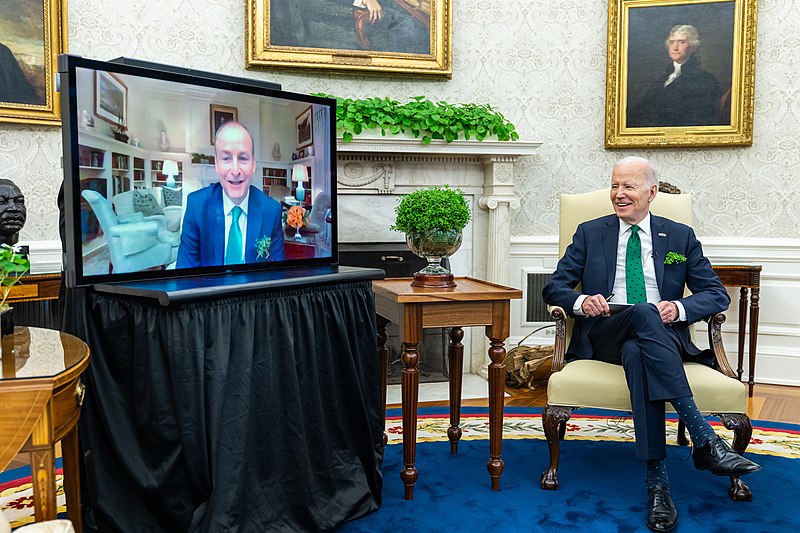
In marking St. Patrick’s Day, US President Joe Biden was to meet in person with Irish Taoiseach Micheal Martin in Washington. However, due to Martin’s COVID-19 positive test, the two leaders met virtually instead.
Biden was to host Martin at the White House over the weekend as part of the annual meeting marking St. Patrick’s Day. But as Martin tested positive for COVID-19, the two leaders met virtually, with Martin self-isolating at Blair House. The virtual meeting between the two leaders started the festivities celebrating the holiday.
During the meeting, Biden and Martin both condemned the ongoing conflict in Ukraine, which rallied many countries together against Russia as it continues its offensive. Martin praised Biden’s leadership throughout the crisis, describing Russia’s unprovoked invasion as “unjustifiable” and “immoral.”
The US leader also reaffirmed Washington’s support for the Good Friday Agreement that was signed in 1998, helping end the violence that has transpired in Ireland for decades over the issue of Northern Ireland reuniting with Ireland or remaining part of the United Kingdom.
Martin was also absent from the annual “Friends of Ireland Luncheon” at the Capitol hosted by House Speaker Nancy Pelosi. Martin and Pelosi also met and spoke virtually.
White House Press Secretary Jen Psaki said that Biden was “disappointed” by the sudden change in the format of his meeting with Martin, saying that the US leader was an “extrovert” and preferred in-person meetings over virtual ones. Psaki added that Biden expressed hope that next year’s meeting for St. Patrick’s Day would go smoothly.
Friday last week, Biden spoke with Chinese President Xi Jinping regarding the ongoing invasion of Ukraine. The call appeared to be an opportunity for Biden to see if China could be convinced not to be involved in the ongoing conflict and to reject Russia’s requests for military and economic assistance. The call was also an opportunity for Biden to issue a stark warning against helping Russia.
While both Biden and Xi agreed on the need to promote peace and assist in the humanitarian efforts, the two leaders did not see eye to eye on who was responsible for the ongoing invasion. Xi apparently refused to say that Russia was solely responsible for the war.
Official readouts from Beijing revealed that Xi believed the US and Europe was responsible for provoking Russian dictator Vladimir Putin into invading Ukraine due to NATO’s eastward expansion.







