
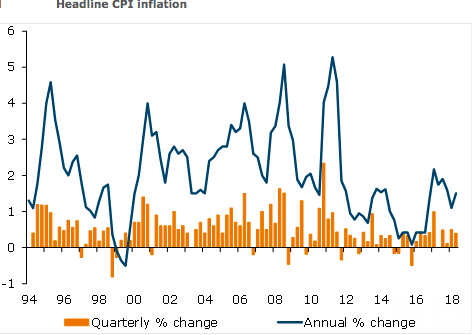
New Zealand’s second-quarter annual consumer price inflation (CPI) bounced back, albeit missing market estimates, while the q/q rate fell in comparison to the previous reading in the first quarter. Following this, the NZD/USD currency pair rose nearly 0.75 percent during European session Tuesday, trading 0.68371 at the time of writing.
Headline CPI rose 0.4 percent q/q in Q2, which was below consensus expectations (0.5 percent) and this saw annual inflation pick up to 1.5 percent y/y from 1.1 percent in Q1. Tradable prices rose 0.3 percent q/q (0.1 percent y/y), while non-tradable prices rose 0.4 percent q/q (2.5 percent y/y). It was the strength in non-tradables inflation that proved to be the biggest surprise.
But there were some offsets. Broadly as expected, the food group rose 0.8 percent q/q and petrol prices rose 3.2 percent q/q. The latter reflecting recent NZD weakness and higher oil prices. Petrol will likely make another positive contribution in Q3 given the recent lifts in fuel taxes.
The housing group remained at the fore, and despite our expectation for the recent deceleration to remain in a holding pattern, housing-related prices proved they haven’t found a limit just yet. The purchase of housing rose 1.1 percent q/q (3.9 percent y/y). This is still below the average of 1.3 percent q/q over the past three years and its peak of 6.7 percent y/y in Q1 2017.
Further, core and underlying inflation measures also strengthened slightly. The trimmed mean measures lifted across all levels of the trim in annual terms and the weighted median gained 0.3 percentage point to 2.3 percent y/y. The focus now turns to the RBNZ’s sectoral factor model estimate, which has ranged between 1.4-1.5 percent since Q3 2015.
"We expect the RBNZ will be looking for inflation to increase in a consistent, broad based way from here and will retain a neutral stance, signalling that the next move in interest rates could still be up or down, until it is confidence the underlying inflation pulse has strengthened," ANZ Research commented in its latest report.

